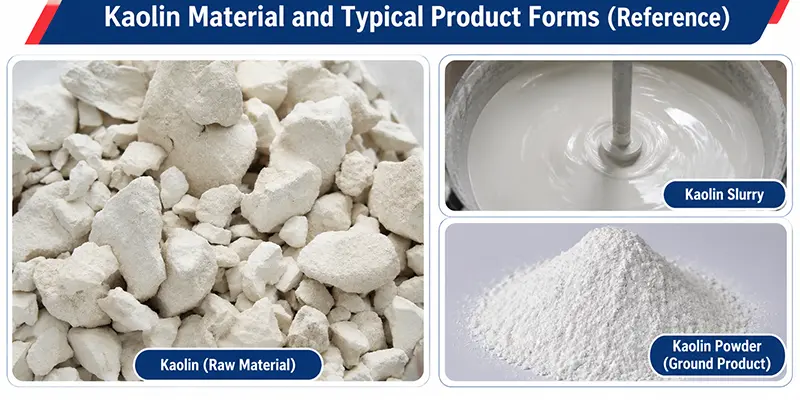
A kaolin processing plant should be designed around the characteristics of the raw material and the required finished product. A feed that mainly needs drying and size reduction presents a different task from a sandy clay that requires dispersion, grit removal and purification.
The first decision is therefore not which mill or separator to buy. It is whether the material can meet the specification through dry processing or needs a wet treatment route. The required delivery form—slurry, filter cake, dry powder or a calcined product—then determines the downstream stages.
This guide explains how these decisions affect the flowsheet and equipment selection, without assuming that every kaolin deposit requires the same production line.
1. What Determines a Kaolin Processing Plant Flowsheet?
Start with the properties that influence separation and product quality.
| Design factor | What to establish | Effect on the flowsheet |
|---|---|---|
| Mineral composition | Kaolinite and associated quartz, mica or other minerals | Identifies what must be separated or retained |
| Feed condition | Loose clay, sandy material, lumps or relatively hard material | Determines preparation and dispersion requirements |
| Impurities | Their mineral form, particle size and association with the clay | Guides the assessment of purification methods |
| Product specification | Particle size, grit residue, chemistry and optical properties | Defines classification and quality-control targets |
| Delivery form | Slurry, filter cake, powder or calcined product | Determines dewatering, drying and finishing stages |
| Site conditions | Water supply, water treatment, utilities and storage | Influences practical plant configuration |
A chemical analysis alone does not explain how easily an impurity can be removed. Mineralogical examination and separation tests help establish whether it occurs as a separate particle, a coating or a constituent that is difficult to separate.
Brightness, whiteness and fired colour should also be specified with their test methods. They are not interchangeable quality measurements.
2. Dry or Wet Kaolin Processing: Which Route Fits the Feed?
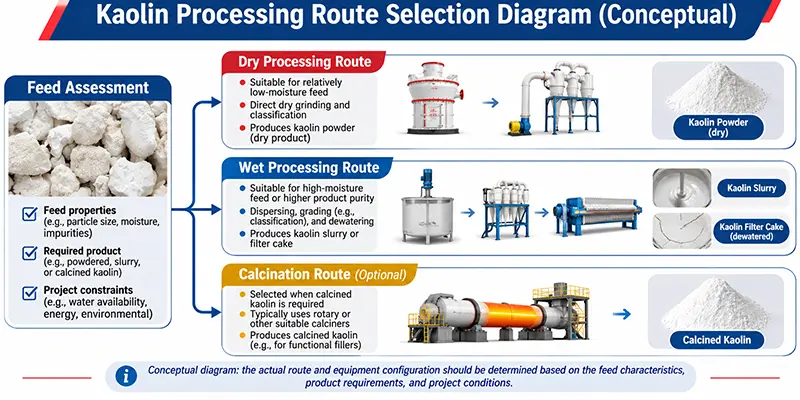
Both dry and wet routes are used in kaolin processing. The appropriate choice depends on the feed and product specification, rather than a rule that one route is always preferable. The distinction is also described in the U.S. EPA’s clay processing overview.
| Route | When it may be considered | Important limitation |
|---|---|---|
| Dry processing | Drying, milling and air classification can produce a suitable product | Fine grinding alone does not establish chemical purity |
| Wet processing | Dispersion, grit removal, fractionation or selected purification is required | Washing alone does not guarantee the final specification |
| Calcination and finishing | The required product needs a controlled thermal transformation | Ordinary drying is not a substitute for calcination |
A dry route may be sufficient where the raw material is suitable and the buyer’s specification permits it. A wet route provides additional opportunities to separate material in slurry form, but introduces water management and dewatering duties.
Do not add every available purification stage to the flowsheet. Each stage should have a defined purpose supported by tests.
3. What Does a Dry Kaolin Processing Line Include?
A conceptual dry route is:
Preparation when required → drying when required → milling → air classification → collection → storage or packing
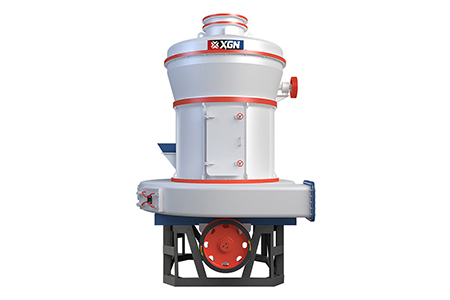
A Raymond mill can be considered for powder preparation where the feed condition and required particle size suit the selected configuration. It should be assessed together with the feeder, classifier, fan and collection equipment.
Preparation may involve breaking lumps or reducing oversized material. Drying depends on the incoming moisture and the requirements of the milling system. Neither stage should be included automatically without checking the feed.
Air classification separates material according to its behaviour in the airflow. It can control product size and reject some coarse material, but should not be presented as a universal method for removing iron- or titanium-bearing impurities.
For applications with demanding particle-size distributions or particle-shape requirements, confirm that the proposed milling method produces the required properties. The ability to make a fine powder is not sufficient evidence that it will meet the end-use specification.
4. What Are the Main Stages of Wet Kaolin Processing?
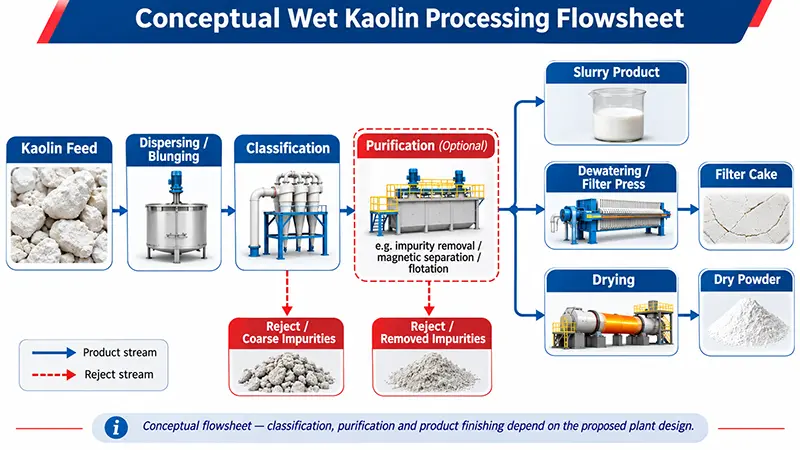
A conceptual wet route is:
Blunging and dispersion → grit removal → classification → purification where required → thickening and filtration → product finishing
Blunging and dispersion
Clay is mixed with water and dispersed to release particles and prepare a workable slurry. Breaking clay aggregates apart is different from grinding individual mineral particles.
A ball mill is therefore not a compulsory starting point for every wet kaolin plant. The preparation method should follow the physical condition of the feed.
Grit removal and classification
Screening and hydraulic classification can separate coarse material from finer clay fractions. The selected equipment and separation conditions depend on the feed and target product.
A fine kaolin-bearing stream may report to an overflow. Do not label every overflow as wastewater or every underflow as the valuable product. Sample and test the streams before deciding their destinations.
Purification and water handling
Additional treatment is selected only when the product requires it and tests show a useful response. Process-water quality and recycling arrangements should be considered because changes in the water circuit can affect slurry behaviour.
5. When Are Magnetic Separation and Other Purification Steps Needed?
The method depends on the impurity rather than simply on the presence of iron in a chemical analysis.
High-intensity or high-gradient magnetic separation may be evaluated for suitable magnetically responsive impurities. A conventional low-intensity wet drum separator should not be treated as an equivalent solution for all fine kaolin purification duties.
The guide to types of magnetic separators explains why equipment selection must account for particle size, magnetic response and operating conditions.
Other options, such as flotation or chemical treatment, require their own testwork. Their inclusion should be justified by improvements in the required product properties and an acceptable loss of valuable material.
Reducing an impurity concentration is not the only objective. Evaluate product quality together with mass yield, water requirements and downstream treatment. A cleaner product with excessive clay losses may not provide a practical process.
6. How Do Product Form and Dewatering Affect Equipment Selection?
The finishing section depends on what the customer needs to receive.
Slurry product: Consider solids concentration, viscosity, settling behaviour and storage or transport requirements. A slurry product may not need the same filtration and drying stages as a powder product.
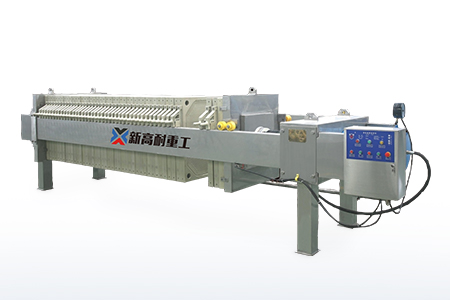
Filter cake: A plate and frame filter press may be evaluated for solid-liquid separation. Confirm filterability, cloth suitability, cycle time and cake moisture through representative tests.
Dry powder: Mechanical dewatering may be followed by drying, deagglomeration, collection and packing. These stages should preserve the required product quality and avoid unwanted contamination.
Calcined product: Calcination changes the material through controlled thermal treatment. It is a separate process decision, with its own product-quality requirements, rather than simply a higher-temperature version of routine drying.
7. What Tests Should Be Completed Before Equipment Selection?
A practical test programme should address:
Mineral composition and the occurrence of unwanted components.
Feed and product particle-size distributions.
Dispersion, settling and slurry-flow behaviour.
Separation performance and product mass yield.
Brightness, whiteness or fired properties using specified methods.
Filtration behaviour, cake moisture and cycle time.
Performance in the intended downstream application.
Record the conditions behind each result. A filtration result without slurry concentration, cloth details and cycle conditions is difficult to use for equipment selection.
For the filtration section, filter press sizing should consider both chamber volume and the complete operating cycle. Filtration area alone does not establish the dry-solids output of the plant.
Do not publish a generic recovery, brightness improvement or production capacity as a promise for an untested kaolin feed.
XINGAONAI’s milling and filtration equipment can be evaluated for the relevant stages of a proposed kaolin processing plant. Confirm the process duties and equipment scope before treating individual machines as a complete beneficiation or calcination solution.