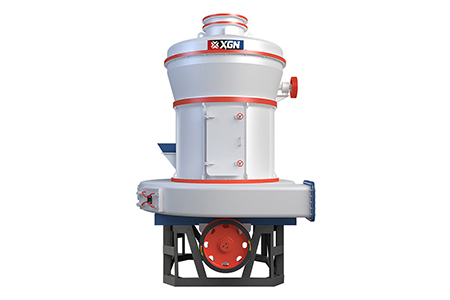
A gypsum grinding mill should be selected according to the material entering the system and the product required at the outlet. Natural gypsum rock, damp industrial by-product gypsum and previously calcined gypsum should not automatically be processed with the same equipment configuration.
For natural gypsum powder preparation, a Raymond mill can be considered where the feed condition and required particle size suit the machine. However, grinding gypsum into powder does not by itself produce calcined plaster.
The practical starting point is to define the material, its moisture condition, the required powder specification and whether calcination is part of the project.
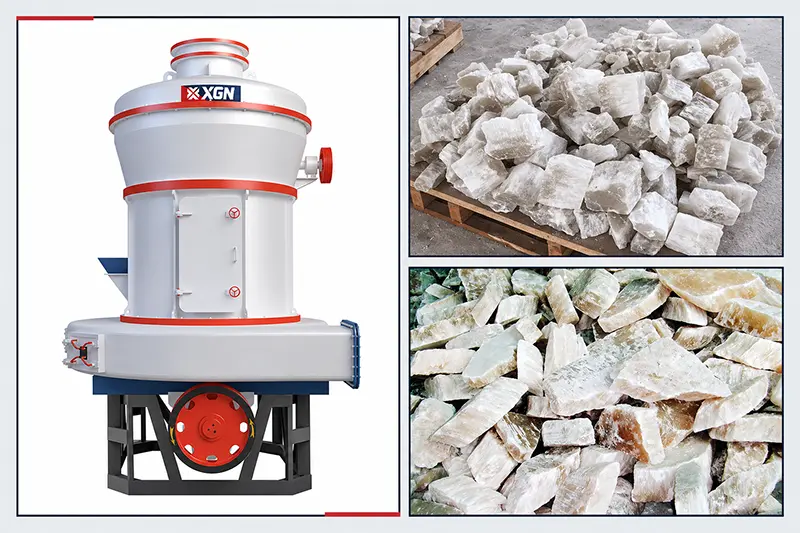
1. What Should You Check Before Selecting a Gypsum Grinding Mill?
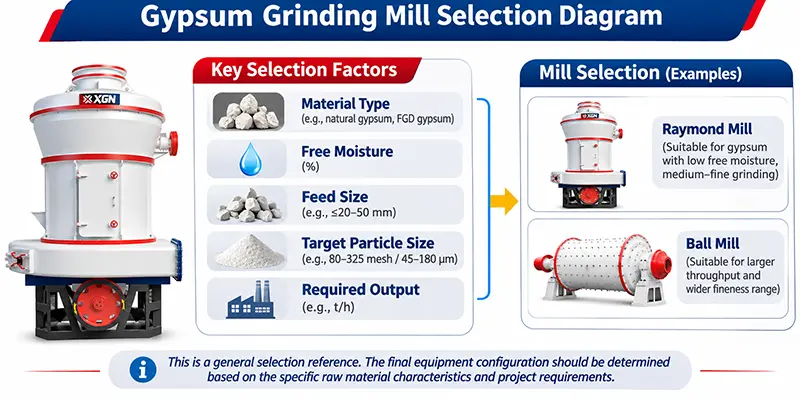
Before comparing machine models, identify the duty the mill needs to perform.
| Selection factor | What to establish | Why it matters |
|---|---|---|
| Material type | Natural gypsum, industrial by-product gypsum or calcined gypsum | Different feed conditions and processing stages require different assessments |
| Feed size | Maximum lump size and normal size distribution | Determines whether pre-crushing is needed |
| Moisture | Free moisture, its variability and the test method used | Influences handling, feeding and possible drying requirements |
| Product specification | Required particle size distribution or sieve residue | Defines the grinding and classification duty |
| Production rate | Required output at the specified product quality | Allows capacity to be assessed under meaningful conditions |
| Downstream use | Raw gypsum powder, feed for calcination or a finished calcined product | Establishes the boundary between milling and thermal processing |
The same phrase—“gypsum powder”—can refer to different products. Confirming the processing stage avoids comparing a raw gypsum grinding system with a complete plaster production system.
2. Is a Raymond Mill Suitable for Gypsum Grinding?
A Raymond mill is a candidate for dry grinding natural gypsum when the material can be fed consistently and the required fineness falls within the capability of the selected configuration.
In a typical roller-and-ring system, the material is ground mechanically, carried by air to a classifier and separated according to particle size. Rejected coarse material returns for further grinding, while accepted powder moves to the collection stage.
The mill should be evaluated together with its feeder, classifier, fan and collection equipment. A larger main motor alone does not establish the output of the complete system.
Evaluate another configuration if the feed is difficult to handle, the required particle size distribution is unusually demanding, or the process requires simultaneous calcination. The equipment decision should follow the material and product requirements rather than a universal preference for one mill type.
3. How Do Fineness, Capacity and Moisture Affect Selection?
Define fineness clearly
A specification such as “200 mesh” may be useful as an initial description, but it is incomplete without the sieve standard and required passing percentage or residue.
Where appropriate, specify particle size distribution indicators such as D50 or D90 and identify the measurement method. These indicators should not be treated as interchangeable with a sieve result.
For example, requiring a stated percentage to pass a particular sieve is different from requiring D90 to fall below a specified particle size.
Confirm capacity at the required fineness
Capacity should refer to acceptable finished powder under defined feed conditions.
A throughput figure without its associated fineness, moisture and material conditions is insufficient for selecting a gypsum grinding mill. Similarly, a capacity measured on limestone or another mineral should not automatically be applied to gypsum.
The final assessment needs to consider the complete circuit, including classification, airflow and powder collection.
Separate free moisture from crystal water
Free moisture is water present on or between particles. Crystal water forms part of the gypsum mineral structure. Removing surface moisture and carrying out calcination are different process objectives.
Moist feed may require conditioning or drying to maintain reliable handling and grinding. If heat is introduced, its effect on the required gypsum product must also be assessed. A hot-air arrangement should not be described simply as “drying only” without checking the operating conditions.
4. What Equipment Is Included in a Gypsum Grinding System?
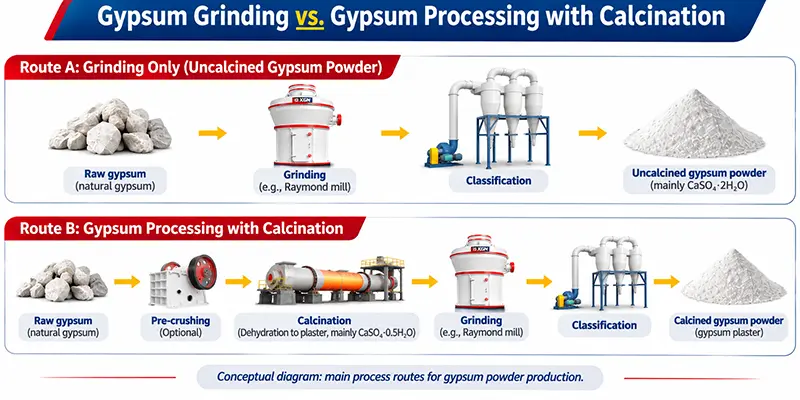
A conceptual dry grinding route for natural gypsum is:
Pre-crushing when required → controlled feeding → grinding → classification → powder collection → storage or packing
Each stage has a specific purpose:
Pre-crushing: Brings oversized lumps within the selected mill’s feed limits.
Controlled feeding: Maintains a consistent load instead of sending irregular surges into the mill.
Grinding and classification: Reduce particle size and separate acceptable powder from material requiring further grinding.
Collection and dust control: Recover powder and manage dust-laden air according to the system design.
Storage or packing: Protect the product from unintended moisture exposure and contamination.
Drying is a conditional stage, not a compulsory feature of every gypsum grinding line. The powder collection arrangement also depends on the selected system.
Where a bag filter is fitted, monitoring baghouse differential pressure can help assess changes in filter resistance. It does not replace measurement of airflow or finished-powder quality.
5. Does Gypsum Grinding Also Produce Plaster?
Grinding mainly changes particle size. Calcination changes the hydration state of gypsum through controlled thermal processing.
This distinction determines what the production line needs to accomplish:
| Required product | Main process consideration |
|---|---|
| Ground natural gypsum | Reduce particle size while maintaining the required material properties |
| Gypsum powder for a downstream calciner | Match the powder specification and feed conditions required by the thermal stage |
| Calcined plaster | Include suitable calcination and product-quality control |
| Previously calcined gypsum requiring further milling | Assess the milling duty in relation to the existing product properties |
Specialized industrial systems can combine grinding, drying, classification and calcination. Other arrangements use separate stages. These alternatives are described in Gebr. Pfeiffer’s gypsum processing information.
Their existence does not mean a standard Raymond mill automatically provides the same thermal-processing capability.
6. Common Mistakes When Selecting a Gypsum Grinding Mill
Selecting by mesh number alone.
Confirm the sieve standard, passing requirement or particle size distribution before comparing equipment.
Treating every gypsum feed as equivalent.
Natural rock and damp industrial by-products may differ in handling characteristics, impurities and preparation needs.
Applying another material’s capacity directly to gypsum.
Use material-specific assessment and clearly defined product conditions.
Assuming the mill determines the whole line’s output.
Feeding, classification, airflow and collection can limit the circuit.
Comparing quotations with different process boundaries.
A grinding package and a complete calcined-plaster system do not cover the same duties.
Ignoring the condition of grinding components.
Roller, ring and classifier condition can affect operation. For component functions and inspection points, see the guide to Raymond mill parts.
XINGAONAI can help assess a Raymond mill configuration against the proposed gypsum grinding duty. The equipment scope should clearly identify whether it covers powder preparation alone or interfaces with a separate thermal-processing stage.