Air-to-cloth ratio tells you how much air or process gas passes through each unit of filter cloth area in a baghouse. It is one of the first figures to check when sizing a pulse jet bag filter for a crushing, screening or grinding plant.
The calculation is straightforward. Selecting a suitable value is more involved: the airflow must represent the operating conditions, the filter area must be defined correctly, and the dust and cleaning system must be considered.
This guide explains the formula, works through an example using a published XINGAONAI model, and shows what information is needed before choosing a collector.
What Is Air-to-Cloth Ratio?
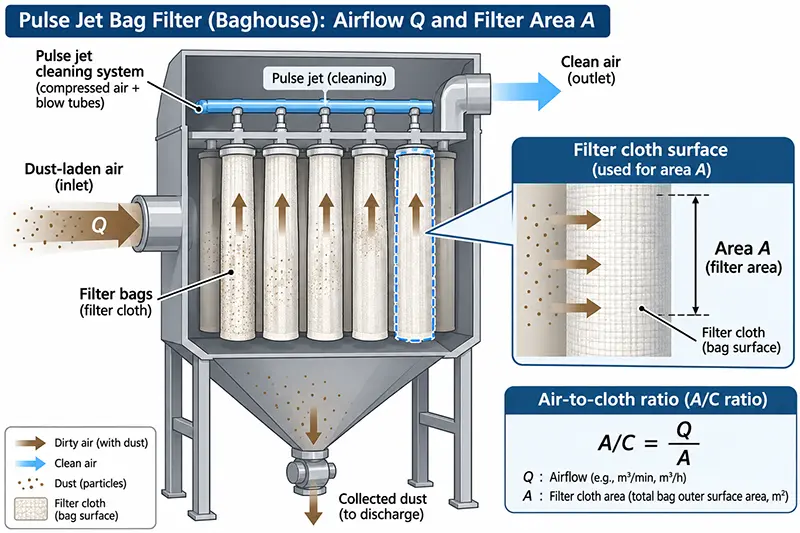
Air-to-cloth ratio is the volumetric airflow divided by the filter cloth area:
Air-to-cloth ratio = Actual airflow ÷ Filter cloth area
If airflow is measured in actual cubic feet per minute (ACFM) and area in square feet, the result is expressed in ft/min. With airflow in m³/h and area in m², divide the hourly airflow by 60 first:
Air-to-cloth ratio (m/min)
= Actual airflow (m³/h) ÷ [60 × Filter cloth area (m²)]
Although the name contains “ratio,” the result has units of velocity. It is often called filtration velocity. The NIOSH Dust Control Handbook for Industrial Minerals Mining and Processing defines it using actual gas flow and filter area.
Which Airflow and Filter Area Should You Use?
Use airflow at the relevant operating conditions
Start with the airflow the collector must handle at the relevant operating conditions. Do not insert a figure expressed at standard conditions into a calculation that requires actual gas volume without checking the conversion.
Temperature, pressure and moisture can affect the actual volume of a process gas. This matters especially when the collector serves hot dryer exhaust rather than ambient air from a crusher enclosure.
Also check whether the quoted airflow covers one pickup point or several points operating together. The air volume required at the collector is a system-design question; it should not be estimated from tonnes per hour of material alone.
Distinguish installed area from available area
Gross air-to-cloth ratio uses the total installed filter cloth area:
Gross ratio = Actual airflow ÷ Total installed cloth area
If a design takes a compartment offline for cleaning or maintenance while the remaining compartments continue filtering, calculate the ratio again using the cloth area available during that condition:
Operating ratio = Actual airflow ÷ Cloth area online
An online pulse jet cleaning arrangement and an offline-cleaned compartment arrangement must not be treated as the same design. The US EPA baghouse guidance distinguishes gross and net filter area where compartments are taken offline.
Before comparing figures from two suppliers, ask what airflow basis and cloth-area basis each has used.
Calculation Example: XINGAONAI LDMC64-8
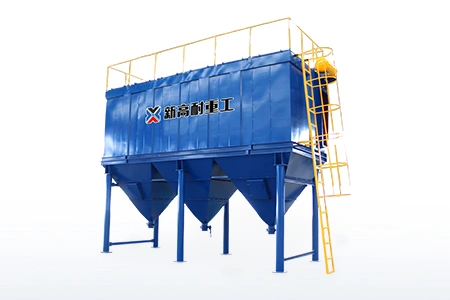
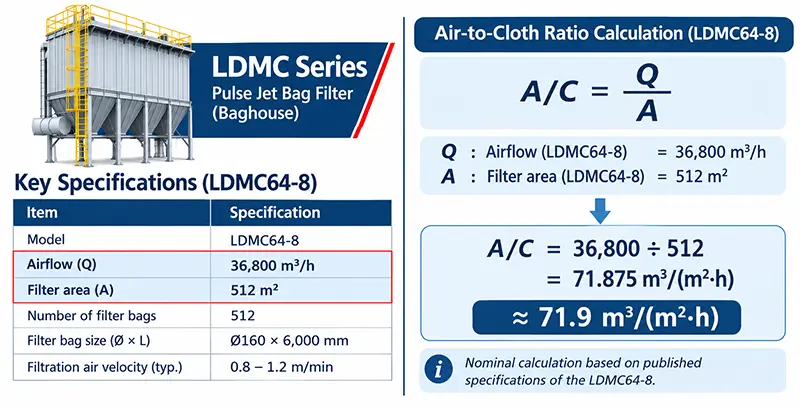
The published specification for XINGAONAI’s LDMC64-8 pulse jet bag filter lists a handling air volume of 36,800 m³/h and a filter area of 512 m².
Using those published figures:
Nominal air-to-cloth ratio
= 36,800 ÷ (60 × 512)
= 36,800 ÷ 30,720
≈ 1.20 m/min
| Input | Published value |
|---|---|
| Model | LDMC64-8 |
| Handling air volume | 36,800 m³/h |
| Filter area | 512 m² |
| Calculated nominal ratio | Approximately 1.20 m/min |
This is an illustrative calculation from the published product table, not a measured result from an operating installation. Before using it for a project, confirm with the engineering team that the stated airflow is on the required actual-volume basis and that the listed area is the appropriate area for the operating arrangement. See the LDMC technical parameters on the product page.
The result also does not establish that 1.20 m/min is suitable for every dust or plant. Suitability depends on the complete duty.
How Do Dust Conditions Affect the Selected Ratio?
A calculated ratio describes airflow per unit of cloth. It does not, by itself, establish that the filter will clean effectively or meet the project’s requirements.
| Factor to check | Why it matters |
|---|---|
| Dust concentration at the inlet | More dust reaches each unit of cloth and may increase the load on the cleaning system |
| Particle-size distribution | Fine particles can form a denser dust cake |
| Moisture and stickiness | Dust that adheres to the bags may be harder to remove |
| Filter medium | The selected fabric must suit the dust and gas conditions |
| Cleaning arrangement | Pulse timing, available compartments and cleaning method affect operation |
| Required airflow | Changing the number or operation of pickup points changes the gas volume reaching the collector |
The EPA’s baghouse guidance cautions that dust loading, particle size and dust cohesiveness must be assessed for each application. The NIOSH handbook discusses dust sources such as crushers, screens and conveyor transfer points in mineral processing.
For a crushing and screening plant, record which points are enclosed or extracted and which operate at the same time. For grinding equipment, include the characteristics of the finer dust and any process-gas temperature or moisture. These details give an engineer a sounder basis for selection than a generic “recommended ratio.”
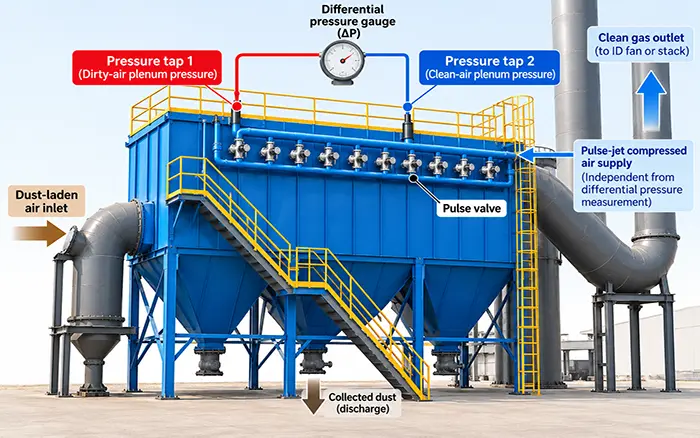
Air-to-Cloth Ratio vs Baghouse Differential Pressure
Air-to-cloth ratio is primarily a design and sizing measure: it relates airflow to available filter area. Differential pressure is an operating measurement: it shows the pressure difference across defined points of the filtration system.
They are connected, but one cannot replace the other. An increasing differential pressure reading may prompt an investigation of airflow, dust loading, filter condition and cleaning performance. It does not prove by itself that the original air-to-cloth ratio was incorrectly selected.
For interpreting high and low readings during operation, see our baghouse differential pressure guide. Keep the actual measurement locations and the collector’s operating baseline in view when assessing a reading.
Information to Provide Before Selecting a Bag Filter
Send the supplier enough information to check both the airflow calculation and the filtration duty:
Material being processed and dust-generating steps.
A list or sketch of the extraction points.
Required airflow at each point and which points run simultaneously.
Whether the stated airflow is actual or referenced to standard conditions.
Gas temperature, moisture and any relevant chemical properties.
Available information on dust concentration and particle size.
Required operating schedule and cleaning arrangement.
Site and project requirements for the exhaust.
Available ductwork layout, fan information and installation space.
If some measurements are not available, identify them as unknown. Do not turn an assumption into a measured project value.
Common Calculation Mistakes
Mixing actual and standard gas volumes. Confirm the airflow basis before using it in the formula.
Using bag count as filter area. Bag quantity alone does not establish the available square metres of cloth.
Ignoring offline compartments. Check whether the stated area remains available in the operating condition being assessed.
Treating one calculated figure as a universal target. Dust and cleaning conditions still need engineering assessment.
Confusing ratio with differential pressure. One is an airflow-to-area calculation; the other is a pressure measurement taken during operation.
Request a Pulse Jet Bag Filter Assessment
XINGAONAI supplies pulse jet bag filters for industrial dust collection. Send the extraction-point layout, required airflow, dust and gas conditions, and operating requirements so the filter area and equipment configuration can be checked for your project.
When comparing quotations, request the airflow basis, installed filter area and cleaning arrangement used for each selection. A ratio without those details is difficult to interpret.