Choosing filter press cloth requires two separate checks: whether the fabric suits the slurry and whether the finished cloth fits the filter plate correctly.
Slurry chemistry, operating temperature, particle characteristics and the required filtrate quality influence fabric selection. Plate design, feed openings, attachment details and sealing arrangements determine the required cloth pattern.
Matching only the colour, approximate thickness or nominal plate size is not enough. Before ordering replacement cloths, confirm both the filtration specification and the finished dimensions.
This guide explains what to check when selecting filter press cloth, when cleaning or replacement may be appropriate, and which information to provide for a quotation.
1. What Does Filter Press Cloth Do?
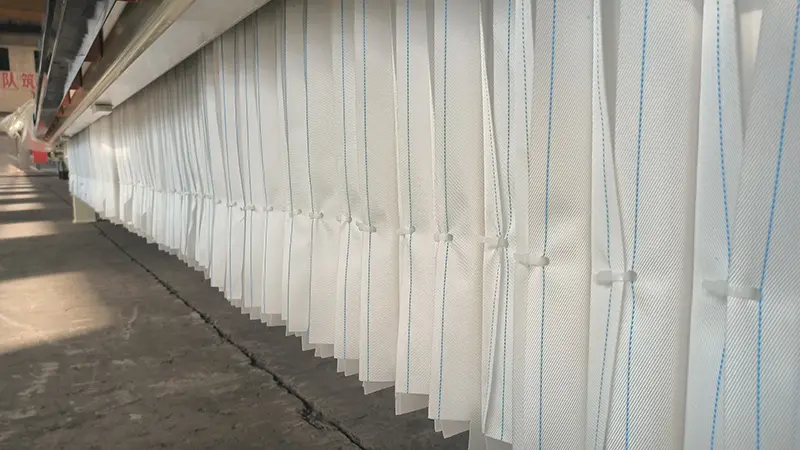
Filter press cloth is the permeable fabric that separates solids from liquid during pressure filtration. It supports the formation of a filter cake while allowing filtrate to pass through to the plate drainage system.
The cloth and the developing cake work together. Filtration performance therefore depends on more than the openings in a clean piece of fabric.
For the broader filtration sequence, see our explanation of the plate and frame filter press working principle.
When evaluating cloth performance, consider several results together:
Filtrate clarity.
Filtration time under comparable operating conditions.
Cake release.
Cleaning requirements.
Mechanical condition of the cloth.
A fabric that produces clear filtrate but blinds rapidly may be unsuitable for the process. Likewise, fast drainage alone does not establish adequate solids retention.
2. Select the Material for the Actual Slurry Conditions
Polypropylene (PP), polyester (PET) and polyamide (PA, commonly called nylon) are among the materials used in industrial filter fabrics. These material names identify polymer families, not complete filtration specifications.
Do not select a cloth from pH alone. Provide the actual process conditions:
Slurry composition and relevant chemicals.
Chemical concentrations where known.
Normal operating temperature and temperature peaks.
Solids concentration.
Particle size distribution and abrasive characteristics.
Cleaning chemicals, their concentrations and cleaning temperatures.
A cloth must tolerate both the slurry and the cleaning procedure. A fabric suitable for the normal process may still be damaged by an incompatible cleaning treatment.
Micronics’ filter cloth selection guidance similarly considers chemistry and temperature alongside particle characteristics, cleanability and cake release.
Where operating conditions have changed, do not automatically reorder the previous cloth specification. Review whether the original material remains appropriate.
3. Check Yarn Structure, Weave and Surface Finish
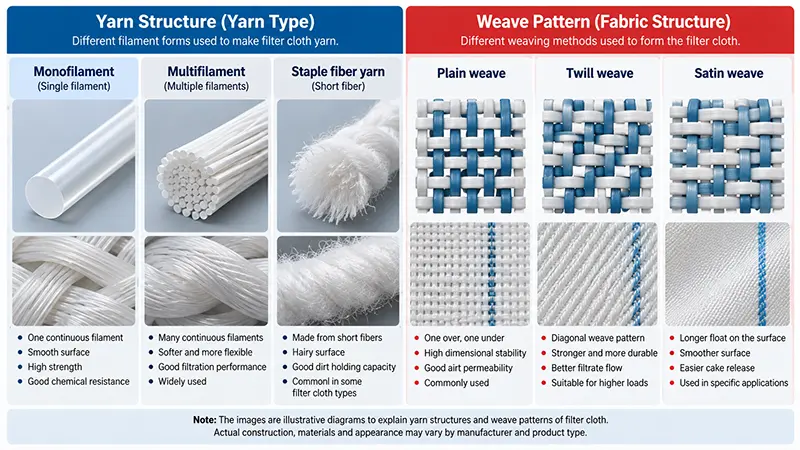
Material, yarn structure and weave describe different aspects of a filter cloth.
Monofilament yarn: A yarn formed from a single continuous filament.
Multifilament yarn: A yarn containing multiple continuous filaments.
Spun yarn: A yarn made from shorter fibres.
The weave describes how the yarns interlace. Surface treatments and finishing can further affect the finished fabric.
Sefar’s filter press cloth technical overview distinguishes monofilament and multifilament fabrics and discusses the role of fabric construction and finishing in filtration and cake discharge.
Avoid treating one yarn type as universally superior. Compare the complete fabric specification against the required balance of retention, drainage, cake release and cleanability.
For replacement orders, an existing fabric code or an original specification is more useful than a photograph of the cloth surface alone.
4. Do Not Confuse Air Permeability with Particle Retention
Air permeability describes airflow through a fabric under specified test conditions. It is not the same as a guaranteed particle retention size in slurry filtration.
When comparing permeability figures, confirm:
The measurement units.
The test pressure difference.
The test method.
Whether the figures refer to comparable fabric conditions.
Values measured under different conditions should not be compared directly.
If a supplier provides a micron rating, ask what the rating means and how it was established. It should not be interpreted automatically as complete capture of every particle above that size.
For a new slurry or a significant process change, representative filtration trials can help assess filtrate quality, cycle time, cake release and cleaning behaviour. Air permeability alone cannot predict all four.
5. Confirm the Replacement Cloth Pattern and Dimensions
The same nominal plate size does not guarantee that two finished cloths are interchangeable.
Plate and frame, recessed chamber and membrane arrangements can require different cloth patterns. Feed connections, attachment methods and sealing details may also vary.
Lamports’ replacement filter cloth guidance distinguishes different cloth arrangements and requests plate measurements to identify the required pattern.
Before ordering, confirm the following details.
| Detail | What to confirm |
|---|---|
| Equipment identification | Manufacturer, press model and serial number where available |
| Plate arrangement | Plate and frame, recessed chamber or membrane design |
| Finished dimensions | Overall width, height and relevant shaped sections |
| Feed opening | Diameter, position and connection details |
| Attachment | Fastening holes, ties, clips or other specified arrangements |
| Edges and sealing | Required edge treatment, gasket arrangement or neck construction, where applicable |
| Installation position | Whether different positions in the plate pack use different cloth patterns |
| Reference documents | Original drawing, cloth code, part number or approved sample |
Photograph both sides of the plate and the cloth as installed. Include close-up images of the feed opening, attachments and sealing areas.
A used cloth can help identify the design, but wear, stretching or shrinkage may make it unsuitable as the only dimensional reference. Check measurements against the plate or the original drawing whenever possible.
6. Decide Whether to Clean, Replace or Review the Specification
Reduced filtration performance does not always mean that the cloth has reached the end of its service life.
First compare the current slurry and operating conditions with the previous stable operating period. A change in feed characteristics can affect results even when the cloth has not changed.
| Observed condition | Appropriate next check |
|---|---|
| Filtration slows without visible cloth damage | Check for blinding and changes in slurry or operating conditions |
| Filtrate becomes cloudy | Inspect cloth integrity, installation and feed or sealing details |
| Cake release becomes more difficult | Review deposits, cloth surface condition and changes in slurry |
| Tears, damaged seams or persistent dimensional problems appear | Assess replacement and investigate the cause of damage |
Before opening the press or removing cloths, follow the equipment isolation procedure and verify that pressure has been fully released.
Use the approved cleaning method for the specific fabric and deposits. There is no universal acid concentration, washing pressure or cleaning temperature suitable for every cloth.
For equipment checks beyond cloth selection, refer to our filter press operation guide and filter press troubleshooting guide.
Do not specify replacement only by calendar age. Mechanical condition, cleaning recovery and performance under comparable conditions provide a more useful basis for the decision.
7. Information to Provide for a Filter Press Cloth Quotation
A clear enquiry reduces the risk of receiving a quotation for fabric that does not fit the plate or suit the process.
| Information | Details to provide |
|---|---|
| Press identification | Manufacturer, model, serial number and nameplate photograph |
| Plate and cloth design | Plate photographs, installation arrangement and original drawing if available |
| Existing specification | Material, fabric code, permeability specification or previous part number |
| Dimensions | Overall dimensions, feed opening, fastening positions and edge details |
| Slurry conditions | Material, solids concentration and available particle size information |
| Chemical and thermal conditions | Process chemicals, concentrations, operating temperatures and cleaning conditions |
| Required result | Filtrate quality requirement and the main problem with the current cloth |
| Supply requirement | Quantity, cloth positions or types, and delivery destination |
If some information is unavailable, identify what is missing rather than substituting estimates without explanation.
Filter press cloth prices depend on the fabric specification, finished size, fabrication details and order quantity. A quotation based only on “cloth for a certain plate size” may leave important requirements undefined.
8. Request Replacement Filter Press Cloth from XINGAONAI
XINGAONAI supplies filter press cloth separately. You can enquire about replacement cloths without purchasing a complete filter press.
Send us your press model, plate photographs, existing cloth reference or drawing, required quantity and slurry conditions. We will review the information to confirm the available supply specification, compatibility and quotation.
If you are also evaluating a complete system, see our plate and frame filter press.
For replacement cloth enquiries, provide both the fabric requirements and the finished cloth pattern. Confirming only one of these is not enough.