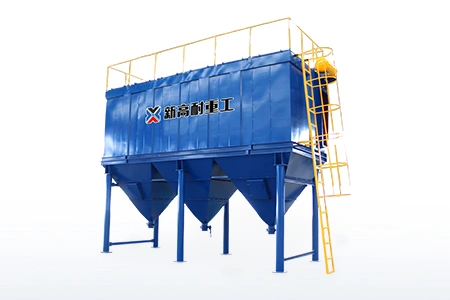
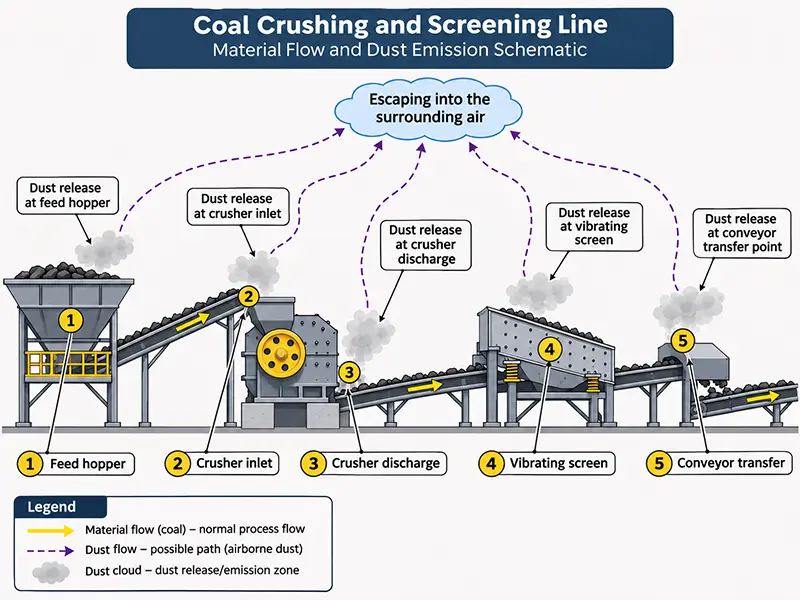
Effective crusher dust control starts at the points where material falls, breaks or changes direction. Check the feed hopper, crusher inlet and discharge, vibrating screens and conveyor transfers while the plant handles representative material. A dust cloud visible beside the crusher may actually be escaping from the discharge chute or the receiving belt below it.
Water sprays can limit dust release where the material and downstream process can accept added moisture. Enclosures help contain airborne dust, and local exhaust draws dust-laden air away from the source. The appropriate combination can vary from one point to another, even on the same line. NIOSH guidance on dust control in crushing and grinding
1. Where Does Crusher Dust Escape?
Walk through the circuit in the direction of material flow. Observe each point during normal production and during events such as truck dumping, uneven feeding or a surge of dry material. Record where dust first becomes visible and where it leaves the equipment.
| Location | What to look for | First point to check |
|---|---|---|
| Feed hopper | A short dust cloud when material enters the hopper | The actual landing area, drop height and open sides of the receiving zone |
| Crusher inlet | Dust escaping around the feed opening or vibrating feeder | Gaps around the feed chute and changes in feed distribution |
| Crusher discharge | Dust escaping below the crusher or around the receiving belt | Discharge enclosure, flexible seals and the condition of the belt loading zone |
| Vibrating screen | Dust escaping at the feed end, around covers or at product outlets | Gaps between moving and stationary parts, along with covers and discharge connections |
| Conveyor transfer | Dust escaping where material falls from one belt to another | Chute containment, skirt seals and how the material lands on the receiving belt |
A dust plume can travel through a chute or enclosure before it becomes visible. If dust appears at the end of a conveyor cover, for example, trace it back to the nearest drop or transfer point before deciding where to place a spray or extraction hood.
2. When Should You Use Water Sprays?
Water sprays can help where surface wetting keeps fine particles from becoming airborne. A typical point to evaluate is the feed or drop zone ahead of the crusher, where water can reach the moving material before it enters the crushing chamber. Nozzle position and coverage should match the actual material stream. NIOSH on wet suppression at crushing points
Check the downstream effect before increasing the water rate. Fine material containing clay may stick to chute walls or blind screen openings when it becomes wetter. If a screen starts passing less undersize, more material may report to the oversize stream. In a closed circuit, that can increase the load returning to the crusher.
During a trial, record the feed condition, spray coverage, product moisture and screen performance together. If the feed hopper benefits from water but the final screen is sensitive to moisture, evaluate different controls for those two points.
3. How Do Enclosures and Local Exhaust Work Together?
An enclosure limits the openings through which dust can escape. Local exhaust ventilation captures dust-laden air through a hood or extraction opening close to the source. A fan moves the air through ductwork to the collector, and the collector separates particles from the air stream.
For a dry collection circuit, a pulse jet bag filter can be evaluated as the filtration stage. Define the extraction points first, then assess the required airflow, dust characteristics, gas conditions and collected-dust discharge arrangement.
If dust escapes around an operating hood, check the opening and seals as well as the extraction branch. Falling material carries air into the enclosure, and an oversized opening can make containment harder. A collector can have a stable pressure drop while one branch still receives inadequate airflow. Check capture at the source under representative operating conditions. NIOSH on enclosure openings and local exhaust
4. How Do You Choose Wet, Dry or Combined Dust Control?
Choose the method point by point. A plant may have an open feed hopper, an enclosed crusher discharge and a fine screen with strict moisture requirements.
| Operating condition | Approach to evaluate | What to verify |
|---|---|---|
| Water is available and added moisture is acceptable | Targeted sprays at the material stream or drop zone, with containment where practical | Spray coverage, product moisture and downstream screening |
| Product moisture is restricted | Enclosure and local exhaust at the source, with filtration selected for the dust and air conditions | Capture at openings, extraction airflow and collector operation |
| Different stages have different moisture limits | A combination, such as sprays at the feed point and dry extraction at moisture-sensitive stages | How upstream wetting affects downstream handling, screening and collected dust |
| Several enclosed points share an extraction system | A common collector with branches designed for the required operating combinations | Airflow at each branch when multiple points operate together |
If the dry system needs a separate stage for coarse particles before fabric filtration, evaluate its pressure loss and dust-discharge requirements. The cyclone vs baghouse guide explains where each type of collector fits.
5. How Was Dust Collection Included in the Argentina Limestone Plant?
XINGAONAI’s 500 TPH limestone crushing and screening plant in Argentina lists one XGN-Q1622 light hammer crusher, two 3YKZ2060 three-deck screens, belt conveyors and one baghouse dust collection system. The fine-crushing line receives pre-crushed limestone up to 20 mm and separates it into 0–5 mm, 5–10 mm and 10–20 mm fractions. The 500 TPH figure is the nominal design capacity.
The case shows where dust collection fits in the equipment scope alongside crushing, parallel screening and conveying. For a similar plant, confirm which sources connect to the collector, which branches operate together and how collected dust is handled. The published case provides an equipment reference. Extraction airflow, collection efficiency and emissions would need separate measurements from the installation.
6. How Do You Troubleshoot Dust That Still Escapes?
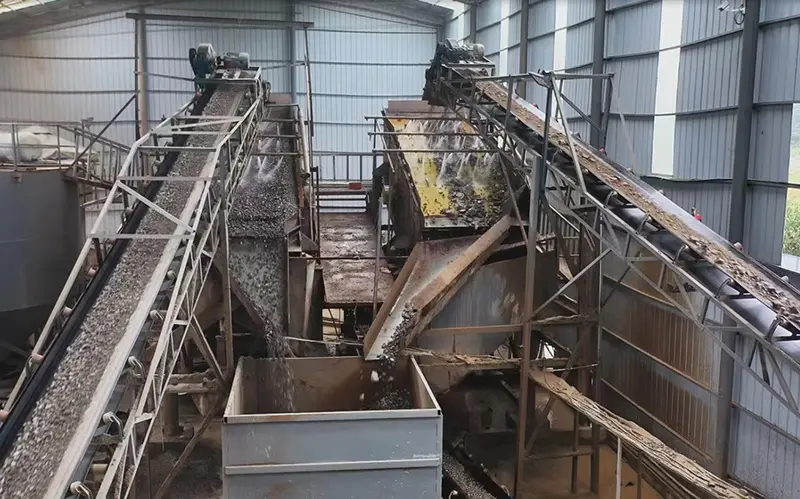
Start with the location and operating event that produce the problem. Check the source and the relevant control before changing the whole system.
| Symptom | Check first | How to verify |
|---|---|---|
| Dust escapes only when the hopper is loaded | Whether the spray reaches the falling stream and whether air is displaced through an open side | Observe several representative loading cycles and record when and where dust escapes |
| Dust escapes at the crusher discharge while extraction runs | Enclosure gaps, damaged seals, duct restrictions and airflow at the relevant branch | Check capture at the opening and measure branch airflow under production load |
| Screening performance drops after water is added | Spray location, coating on the screen media and feed moisture | Compare screen blinding, product sizing and moisture at comparable feed rates |
| One point emits dust while collector pressure drop stays stable | The local hood, branch and operating state of other extraction points | Check the affected branch while the expected equipment combination is running |
For the collector itself, trend baghouse differential pressure together with operating conditions and airflow. When reviewing filtration area for the airflow the system must handle, use the air-to-cloth ratio guide as a separate sizing reference.
Define the test objective before comparing results. Visible dust observations help locate leaks. Airflow measurements help assess source capture. Stack testing and personal exposure sampling answer different questions and require their own measurement methods. For a before-and-after comparison, record the material, feed rate, operating equipment, relevant weather conditions and measurement locations. NIOSH field study on dust controls near conveyors
If you are reviewing a crushing plant dust-control layout, share the process flowsheet and photos of the points where dust escapes. XINGAONAI can use those details to discuss where collection equipment fits into the crushing, screening and conveying circuit.