Baghouse differential pressure is the pressure difference between the dirty-air and clean-air sides of a dust collector. It helps operators understand resistance to airflow, but one reading cannot establish whether the system is working correctly.
A high reading may indicate increasing resistance, ineffective cleaning or a change in operating conditions. A low reading may reflect reduced airflow, a measurement problem or a loss of filter integrity.
The useful question is therefore not simply, “Is the pressure high or low?” It is, “How does this reading compare with the equipment requirements and the system’s previous performance under comparable conditions?”
This guide explains how to interpret baghouse differential pressure, recognise meaningful trends and decide what to check before adjusting cleaning settings or replacing filter bags.
1. What Is Baghouse Differential Pressure?
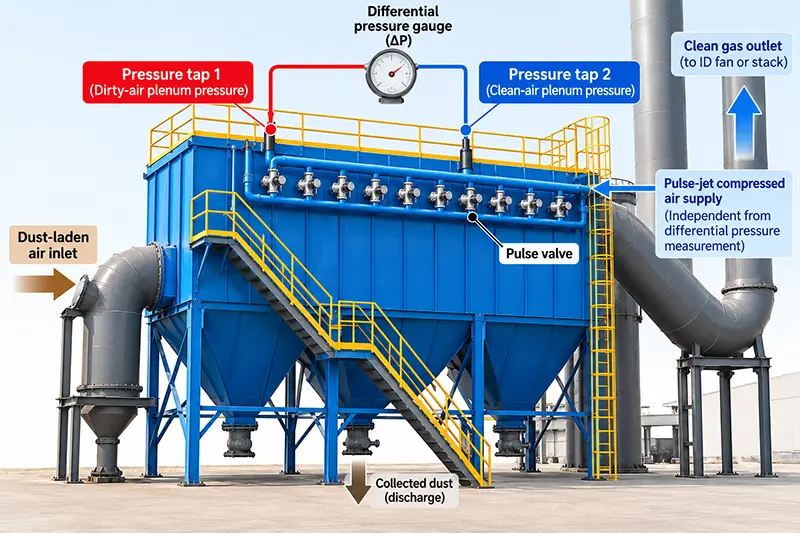
Differential pressure, often written as DP or ΔP, measures the difference between two defined pressure points.
For measurements between the dirty-air and clean-air plenums:
ΔP = P_dirty-air side − P_clean-air side
Both readings may be negative in a suction system. For example:
Dirty-air side pressure: −1,000 Pa.
Clean-air side pressure: −2,200 Pa.
Differential pressure: −1,000 − (−2,200) = 1,200 Pa.
This is a calculation example, not a recommended operating value or a field measurement.
The measured resistance depends on what lies between the pressure taps. Do not confuse differential pressure across the collector with the total pressure loss of the entire duct system.
Also distinguish it from pulse-jet compressed-air pressure. Compressed air supplies the cleaning pulses; differential pressure describes resistance in the filtration airflow path.
For an explanation of filtration and cleaning, see the pulse jet bag filter working principle.
2. What Is a Normal Baghouse Differential Pressure Range?
There is no universal normal differential pressure range for every baghouse.
The appropriate range depends on the collector design, filter media, airflow, dust characteristics, cleaning arrangement and measurement locations. A value suitable for one installation may be unsuitable for another.
Start with the manufacturer’s operating documentation. Then establish a baseline while the equipment is known to provide satisfactory dust capture and filtration.
Record:
Differential pressure before and after cleaning.
Airflow, where measured, and relevant fan or damper settings.
Process operating rate and dust conditions.
Cleaning frequency and operating mode.
Available outlet dust or emissions information.
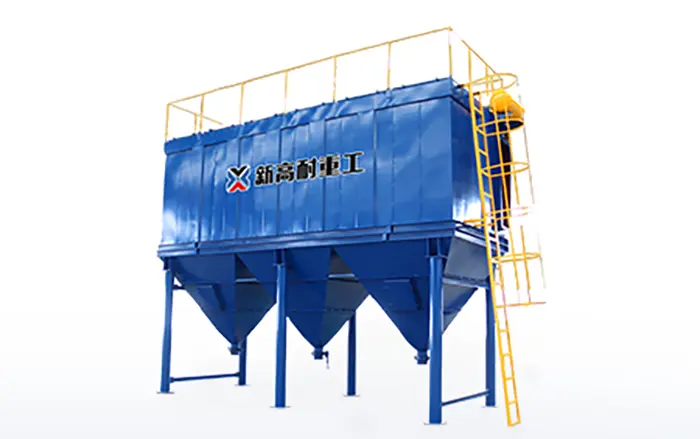
XINGAONAI’s published pulse jet bag filter specifications list pressure-loss figures of 1,470–1,770 Pa for the models shown. These figures should not automatically be used as cleaning start, cleaning stop or alarm settings. Confirm their meaning and application against the documentation for the specific equipment.
Always check the displayed units. Pa, kPa and inches of water gauge are different scales; an unchanged number with a different unit does not represent the same pressure.
3. What Causes High Differential Pressure?
High differential pressure means that the measured resistance is higher than expected for the operating condition. It does not identify the cause by itself.
Possible causes include:
Dust accumulation or filter-media blinding.
Ineffective pulse cleaning.
Insufficient compressed-air availability at the cleaning manifold.
Malfunctioning valves or cleaning controls.
Wet or sticky deposits associated with moisture or condensation.
Changes in airflow or dust loading.
Hopper discharge problems and accumulated material.
Before diagnosing the filters, confirm that the instrument and pressure lines are giving a reliable reading.
Next, check whether cleaning reduces differential pressure. A temporary reduction suggests that cleaning is having an effect, but it does not prove that the entire system is operating correctly.
If the reading remains high, investigate the cleaning system, airflow and process conditions before simply increasing pulse frequency or pressure.
Where production or extraction requirements have changed, review the original pulse jet bag filter design conditions.
4. What Does Low Differential Pressure Mean?
Low differential pressure is not automatically evidence of better filtration.
A low reading may occur because less air is passing through the collector. It may also result from a measurement fault or a leakage path that allows gas to bypass the intended filtration route.
Interpret the reading alongside other observations:
Low DP with poor dust capture: Check airflow, fan operation, dampers, duct restrictions and the measurement system.
A sudden DP drop with increased outlet dust: Investigate filter integrity, bag installation and sealing.
Low DP after filter replacement: Compare the reading with the commissioning procedure and required airflow.
An unusually steady reading despite operating changes: Check the pressure taps, tubing, instrument and signal.
Differential pressure is one performance indicator. The US EPA also identifies outlet particulate concentration, airflow, temperature and cleaning-system operation as relevant monitoring information. DP alone cannot demonstrate satisfactory emissions performance. EPA fabric-filter monitoring guidance
5. Read the Trend, Not Just the Number
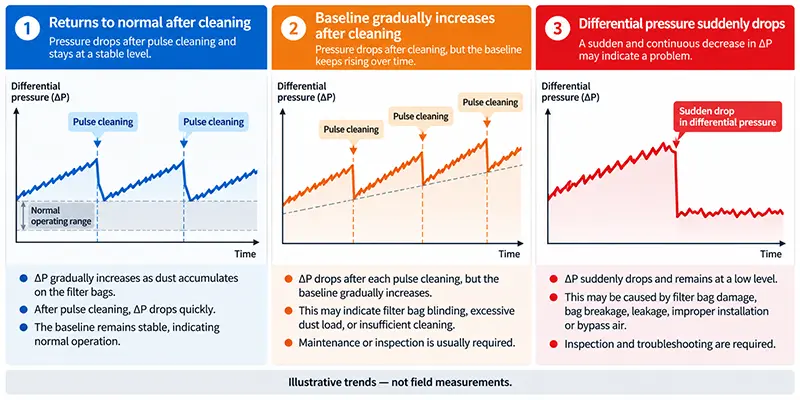
A single pressure reading can hide a developing problem.
For example, the indicated operating range may remain similar while the collector cleans increasingly often. The control system may be using more cleaning cycles to maintain the same apparent DP.
Compare trends under similar airflow and process conditions. The EPA’s fabric-filter maintenance manual explains that airflow affects pressure drop and must be considered when comparing readings. EPA operation and maintenance manual
| Observed trend | Possible interpretation | First checks |
|---|---|---|
| DP gradually rises and recovers less after cleaning | Increasing deposits, reduced cleaning effectiveness or changing process conditions | Measurement reliability, airflow and cleaning records |
| DP remains in a similar range, but cleaning becomes more frequent | More cleaning is needed to maintain the previous condition | Dust loading, compressed-air availability and control records |
| DP suddenly falls and outlet dust increases | Possible filter-integrity or sealing problem | Bag condition, installation and bypass paths |
| DP is low and dust capture deteriorates | Possible airflow reduction or measurement problem | Fan, dampers, ductwork and pressure lines |
| DP barely changes despite major operating changes | Possible measurement or signal problem | Pressure taps, tubing, instrument and signal |
These are investigation directions, not definitive diagnoses.
6. What to Check Before Adjusting Cleaning or Replacing Bags
Use a consistent sequence:
Verify the measurement. Confirm units, instrument condition, pressure-tap condition and tubing integrity.
Compare operating conditions. Check whether airflow, fan settings, production rate or material characteristics have changed.
Review cleaning operation. Confirm that the controller calls for cleaning and that the intended cleaning sequence occurs.
Check compressed-air availability. Assess conditions at the collector manifold, not only at the compressor.
Review moisture and dust discharge. Investigate condensation, sticky deposits, hopper accumulation and discharge operation.
Assess filter condition. Consider damage, persistent restriction, unsuitable media or installation problems after the earlier checks.
Before internal inspection or maintenance, follow the equipment isolation procedure and release stored pressure as required.
On-demand cleaning commonly starts at a high DP setpoint and stops at a lower one. Some controllers also have separate alarm functions; an alarm value is not necessarily the cleaning-start value. Confirm the actual controller configuration. Donaldson on-demand cleaning guidance
Do not change settings simply to make an alarm disappear. Adjustments should remain within the approved equipment and process requirements.
7. What Operating Information Should You Record?
A short, consistent log is more useful than isolated photographs without operating context.
| Information | What to record |
|---|---|
| Date and operating state | Time, production status and whether the system is starting, running or stopping |
| Equipment identification | Collector model and compartment, if applicable |
| Differential pressure | Reading, unit and whether it was recorded before or after cleaning |
| Airflow and fan information | Measured airflow where available, fan speed and relevant damper positions |
| Process conditions | Material, production rate and notable dust-load changes |
| Cleaning operation | Mode, frequency, sequence status and available manifold-pressure information |
| Temperature and moisture | Gas temperature and signs of condensation or wet deposits |
| Dust capture and outlet condition | Observations, available monitoring readings and any deterioration |
| Maintenance actions | What changed and the result under comparable operating conditions |
If airflow is not measured, state that it is unavailable. Fan speed alone does not establish the actual airflow.
Photographs and video can support the record, but they cannot establish a pressure trend or prove emissions performance without the corresponding measurements.
8. Discuss Your Baghouse Operating Conditions with XINGAONAI
If you are evaluating a pulse jet bag filter, provide the required airflow, dust characteristics, gas temperature and relevant process conditions so that the equipment configuration can be reviewed.
For an enquiry involving abnormal DP, include:
Collector model and available technical documentation.
Current and previous DP readings, with units.
Measurement locations and instrument photographs.
Cleaning mode and available operating records.
Airflow information and recent process changes.
A description of dust-capture or outlet-dust problems.
These details help define the enquiry. Differential pressure alone is not enough to determine the appropriate equipment configuration or replacement requirement.