A phosphate beneficiation solution should match the ore’s mineral composition, liberation characteristics and required concentrate quality. Washing and desliming may be sufficient for some material fractions, while other ores require grinding and selective flotation.
XINGAONAI’s grinding and flotation equipment can be evaluated for the relevant processing stages. Equipment configuration should follow mineralogical analysis and beneficiation tests rather than one fixed production-line template.
The objective is to produce a suitable phosphate concentrate while controlling phosphorus losses, impurities, moisture and process-water requirements. Beneficiation prepares the mineral product; phosphoric acid and fertilizer manufacture involve separate downstream processes.
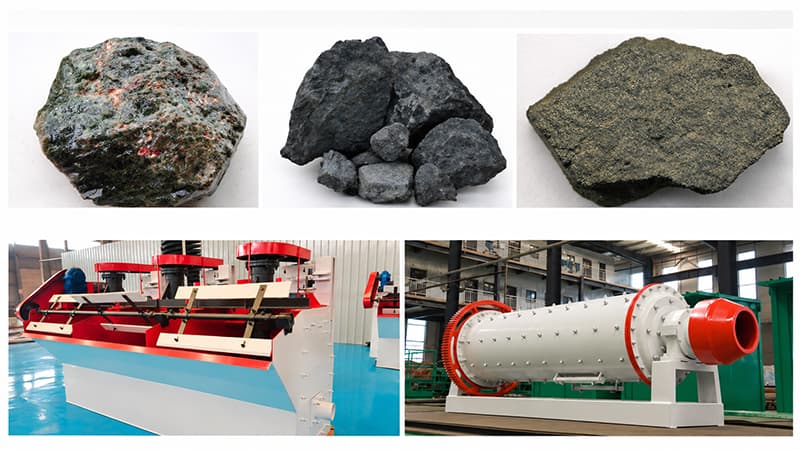
1. Phosphate Ore Types and Processing Challenges
The minerals associated with phosphate influence preparation, separation and product quality. Chemical assays identify impurity levels, while mineralogical examination helps explain how those impurities occur and whether they can be separated.
| Ore condition | Main processing challenge | Candidate processing direction |
|---|---|---|
| Weathered or clay-rich material | Clay coatings, aggregates and fine-slime interference | Scrubbing, washing, screening and desliming |
| Siliceous phosphate ore | Separating quartz and other silicate gangue | Tested direct or reverse flotation |
| Carbonate-rich phosphate ore | Separating dolomite, calcite or associated carbonates | Selective flotation based on actual mineral response |
| Mixed siliceous-carbonate ore | Removing different gangue components | A staged or combined flotation route |
| Hard ore with locked phosphate minerals | Achieving sufficient liberation | Crushing, grinding and classification where required |
| Feed with suitable coarse fractions | Recovering acceptable material without unnecessary grinding | Size classification and assessment of separate treatment |
These are options for evaluation, not universal operating instructions. Sedimentary and igneous deposits can have different characteristics, and significant variation may also occur within one deposit.
The U.S. EPA’s phosphate rock processing overview describes different arrangements for different ores. Regional examples should not be copied as standard design conditions for a new project.
2. Phosphate Beneficiation Process Options
Washing and Desliming Route
Where the feed responds to washing and physical separation, a conceptual route is:
Feed preparation → scrubbing and washing → screening and classification → assessment of separated fractions → product handling or further treatment
Washing can remove clay coatings and disperse aggregates. Classification separates fractions for evaluation, but each stream must be sampled before it is designated as product or reject.
This route does not automatically remove finely associated silica or carbonate gangue. Additional separation may be required.
Grinding and Flotation Route
Where liberation and selective separation are necessary, a conceptual route is:
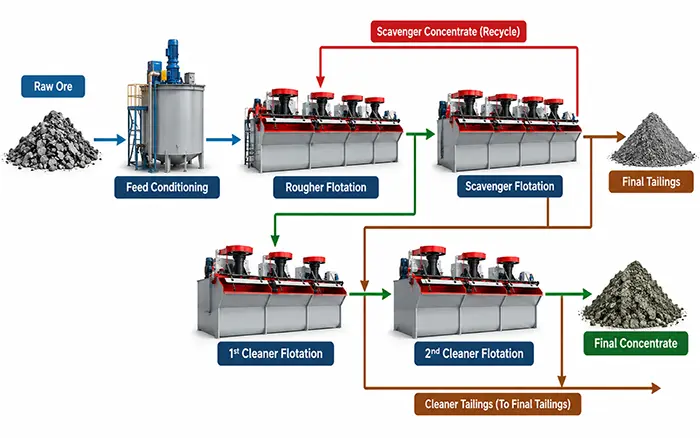
Crushing where required → grinding and classification → feed conditioning → selected flotation stages → concentrate dewatering → product handling
A ball mill may be evaluated for wet grinding. The target size should follow liberation and separation tests. Grinding every feed to the same mesh number can leave some ores under-liberated and unnecessarily overgrind others.
A mechanical flotation machine may be considered for the tested separation duty. Its suitability depends on slurry flow, particle size, residence time, air dispersion and the circuit arrangement.
Desliming may be located before or after a grinding stage, or applied separately to selected streams, according to the test results. Not every fraction must pass through the same route.
3. Direct and Reverse Phosphate Flotation
The principal distinction is which material is intentionally floated.
| Flotation route | Intended froth product | Typical phosphate-rich product |
|---|---|---|
| Direct flotation | Phosphate minerals | Froth stream |
| Reverse flotation | Selected gangue minerals | Non-froth stream |
| Combined flotation | Different components in successive stages | Defined separately at each stage |
Direct flotation aims to recover phosphate into the froth while limiting gangue recovery. Reverse flotation removes selected gangue in the froth and retains phosphate mainly in the non-froth product.
Silicate and carbonate gangue may need different reagent conditions. Mixed ores can require separate stages, but the sequence, conditioning and reagent programme should be established through testing.
Arkema’s phosphate flotation information similarly emphasizes ore-specific reagent programmes and flowsheet development.
Each outlet must be labelled according to its duty. In a reverse circuit, the froth must not automatically be labelled “phosphate concentrate.” General stage arrangement and recycle considerations are discussed in the guide to flotation flowsheet design.
4. Equipment for Each Processing Stage
Equipment should be selected by its assigned duty rather than simply because it appears in another phosphate plant.
| Processing stage | Equipment to evaluate | Main selection considerations |
|---|---|---|
| Feed preparation | Feeders, crushers, washing or scrubbing equipment where required | Feed condition, lump size, clay content and throughput |
| Grinding and classification | Ball mill with an appropriate classifier | Liberation target, grindability, slurry flow and circulating load |
| Flotation preparation and separation | Conditioning equipment and flotation machines | Reagent conditions, solids concentration, residence time and stage duty |
| Concentrate dewatering | Thickening and filtration equipment | Filterability, product moisture, cycle time and handling requirements |
| Tailings and water handling | Suitable dewatering, pumping and water-treatment arrangements | Fine-particle behaviour, water quality and site requirements |
Nominal equipment capacity does not establish concentrate grade or plant recovery. Machinery selection, process conditions and the material balance must be assessed together.
There is also no automatic requirement to include a crusher or mill for every fraction. Avoid unnecessary size reduction where a suitable product or separation feed can be recovered earlier.
5. Concentrate Quality and Phosphorus Recovery
A higher P₂O₅ grade does not by itself establish a successful flowsheet. Product requirements may also involve MgO, SiO₂, iron, aluminium, particle size and moisture.
Assess concentrate quality alongside mass yield and overall P₂O₅ recovery:
P₂O₅ recovery (%) =
[Concentrate dry mass × Concentrate P₂O₅ grade]
÷ [Feed dry mass × Feed P₂O₅ grade] × 100
Use the same grade units, a consistent dry-mass basis and the same sampling period. Where several phosphate products are recovered, include the P₂O₅ contained in all relevant product streams.
The process boundary matters. Recovery calculated from flotation feed does not include phosphorus already lost during washing or desliming.
Removed slimes can contain phosphate as well as clay. Evaluate their mass and P₂O₅ distribution before treating them as final waste. An operating change should be assessed for both concentrate quality and total phosphorus recovery.
6. Concentrate Dewatering and Process-Water Management
Thickening increases slurry solids concentration, while filtration removes additional water to produce a cake. Their duties and achievable results depend on the actual material.
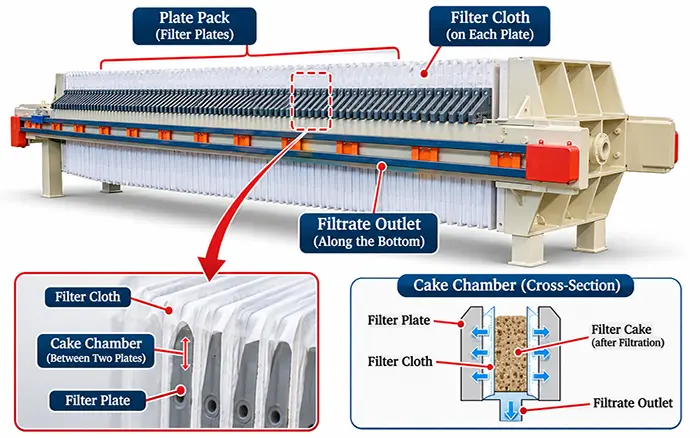
For pressure filtration, representative tests should establish cake formation, suitable cloth, filtration time and final moisture. Filter press sizing needs to account for chamber volume and the complete operating cycle, not filtration area alone.
Concentrate and fine clay-rich tailings can have very different dewatering behaviour. Test them separately rather than transferring one stream’s results to another.
Recovered water may be returned to the process after its suitability has been assessed. Suspended solids, dissolved constituents and residual reagents can influence flotation, so water recovery and water quality should be evaluated together.
7. Information Needed to Evaluate Your Phosphate Project
For an initial equipment discussion, provide the information already available:
Ore source and a description of the feed.
Chemical assays, including P₂O₅ and relevant impurities.
Mineralogical or liberation information, if available.
Feed size distribution and moisture.
Required throughput, stating dry or as-received basis.
Target concentrate quality and intended downstream use.
Existing beneficiation and dewatering test results.
Site conditions, available water and the proposed equipment scope.
If information is missing, identify it as unknown rather than assuming a value. Representative testwork should address variability as well as one selected sample.
XINGAONAI can discuss grinding and flotation equipment for the defined duties. Any proposed process, supply boundary and performance conditions should be confirmed before final model selection.
8. Frequently Asked Questions
Does all phosphate rock need flotation?
No. Some fractions may meet requirements after washing, classification or other suitable separation. Flotation is evaluated when simpler stages cannot adequately separate phosphate from gangue. Mineralogy and beneficiation tests should determine the route.
What is the difference between direct and reverse flotation?
Direct flotation intentionally recovers phosphate minerals into the froth. Reverse flotation intentionally floats selected gangue while phosphate remains mainly in the non-froth stream. Combined circuits must define the product direction at every stage.
How is grinding fineness selected?
Grinding fineness should be based on mineral liberation and subsequent separation performance. Undergrinding can leave phosphate locked with gangue, while unnecessary fine grinding can create slimes and increase processing demand. No single mesh specification suits every ore.
Can desliming cause phosphorus losses?
Yes. The removed fine fraction may contain phosphate minerals. Desliming can improve downstream flotation while reducing total phosphorus recovery. Assay both retained and removed streams and assess the complete process balance.
Can concentrate grade and recovery be guaranteed before testing?
Reliable project-specific commitments require representative testwork, defined feed conditions and an agreed process scope. A generic equipment capacity or another mine’s results cannot establish the grade and recovery of an untested ore.