

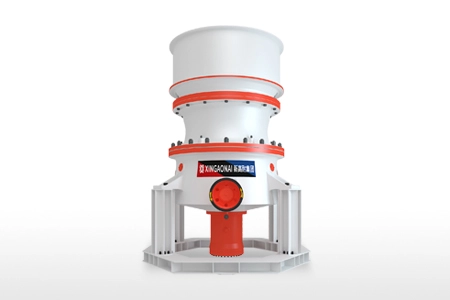
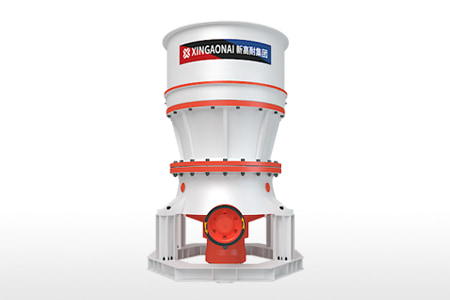
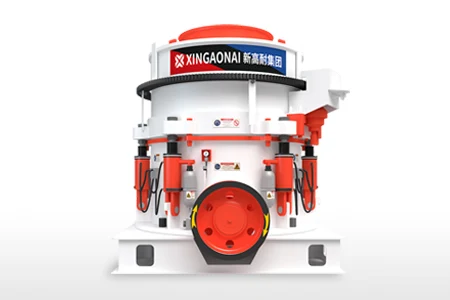
1. Definition: What is a Single Cylinder Hydraulic Cone Crusher?
Compared with multi-cylinder hydraulic cone crushers, this equipment has a more compact structure, simpler operation, and lower maintenance costs, making it particularly suitable for small and medium-sized mines, construction waste recycling plants, and aggregate production lines with limited site space and budget.
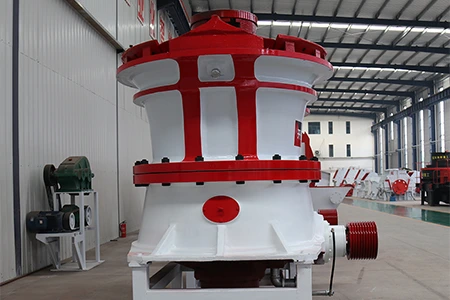
2. Core Working Principles: How Does It Operate?
Material Feeding: The raw material is evenly fed into the crushing cavity through the feeding device. The crushing cavity, composed of a fixed cone (concave) and a moving cone (mantle), has a special shape that allows the material to be gradually squeezed and crushed as it moves downward.
Crushing Process: Driven by the motor and transmission device, the moving cone rotates eccentrically around the central axis. This rotation causes the gap between the moving cone and the fixed cone to alternately expand and shrink. When the gap shrinks, the material is crushed by extrusion, shearing, and bending forces; when the gap expands, the crushed material falls downward under the action of gravity.
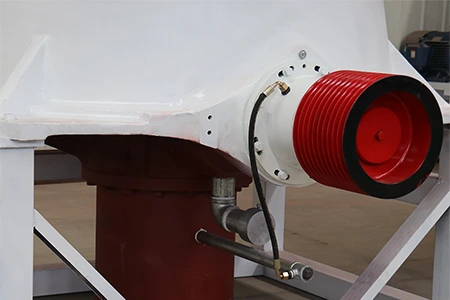
Hydraulic System Regulation: The single hydraulic cylinder installed at the bottom of the equipment plays a crucial role. If the discharge port needs to be adjusted to change the particle size of the finished product, the hydraulic cylinder can push the moving cone up or down to adjust the gap. When encountering uncrushable materials (such as iron blocks), the hydraulic system will automatically release pressure to move the moving cone downward, allowing the foreign matter to pass through, thus avoiding equipment damage—this is the unique overload protection function.
3. Key Advantages: Why Choose a Single Cylinder Hydraulic Cone Crusher?
High Crushing Efficiency: The optimized crushing cavity design and laminar crushing principle enable the equipment to process more materials per unit time. Compared with traditional spring cone crushers, its production capacity can be increased by 15%-20%, making it an ideal choice for high capacity hydraulic cone crusher demand scenarios.
Energy Saving and Environmental Protection: The single hydraulic cylinder structure reduces the overall energy consumption of the equipment. The advanced dust-proof and noise-reducing design also meets the increasingly strict environmental protection standards, which is in line with the market trend of energy efficient single cylinder cone crusher.
Easy Maintenance: The simplified structure means fewer wearing parts and easier replacement. The hydraulic system's automatic cavity cleaning function can quickly handle material blocking problems, reducing downtime and maintenance labor costs—this is a major advantage for users who value easy maintenance single cylinder cone crusher.
Stable and Reliable Performance: The hydraulic overload protection system effectively avoids equipment failures caused by foreign matters, and the high-strength alloy materials used in the moving cone and fixed cone ensure long service life, even when crushing hard materials like granite.
Flexible Application: By replacing different types of crushing cavities (such as standard cavity, medium cavity, and fine cavity), the equipment can realize crushing requirements of different particle sizes, adapting to scenarios such as single cylinder cone crusher for mining and single cylinder cone crusher for granite.
4. Common Application Scenarios
Mining Industry: Used for secondary and tertiary crushing of metal ores (iron ore, copper ore) and non-metallic ores (coal, gypsum), providing qualified raw materials for mineral processing.
Aggregate Production: Produces high-quality construction aggregates (coarse sand, gravel) for highways, railways, bridges, and real estate projects, with the finished product having good grain shape and uniform gradation.
Construction Waste Recycling: Crushes concrete blocks, brick fragments, and other construction waste into recycled aggregates, realizing resource reuse and conforming to the concept of circular economy.
Cement Industry: Crushes limestone, clay, and other raw materials for cement production, ensuring the fineness of raw materials meets the requirements of the cement burning process.
5. How to Choose the Right Single Cylinder Hydraulic Cone Crusher?
Material Properties: Clarify the hardness, moisture content, and particle size of the raw material. For example, crushing hard granite requires a model with higher crushing force, while processing wet limestone needs to pay attention to the anti-blocking performance of the equipment.
Production Requirements: Determine the required hourly output and finished product particle size. Small and medium-sized production lines can choose models like SC100, while large-scale mines may need high-capacity models like SC750.
Site Conditions: Consider the site space, power supply, and transportation conditions. The compact structure of the single cylinder hydraulic cone crusher is more suitable for narrow sites.
After-sales Service: Choose manufacturers with perfect after-sales service, as timely maintenance guidance and spare parts supply can reduce equipment downtime.