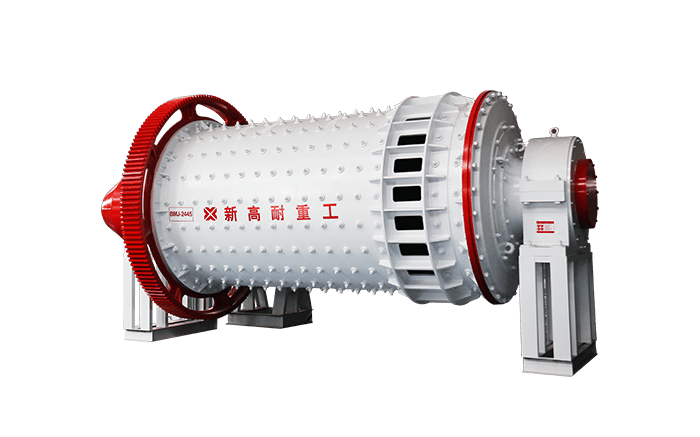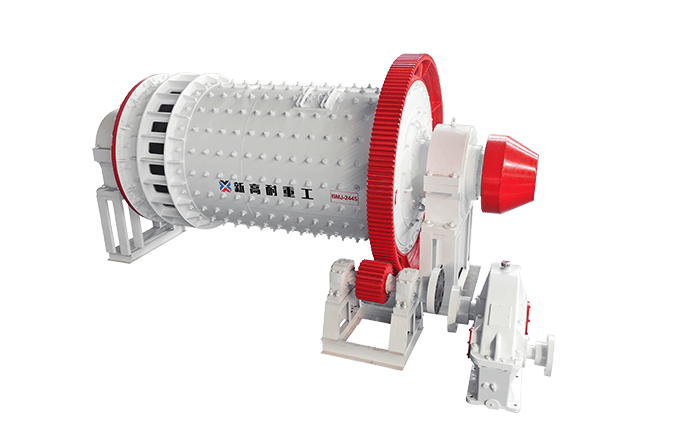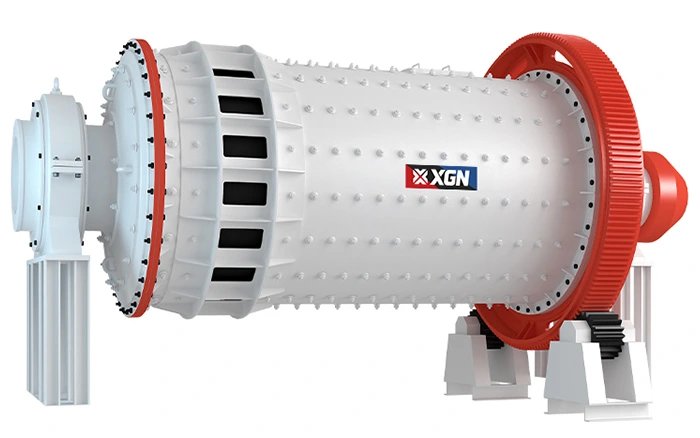
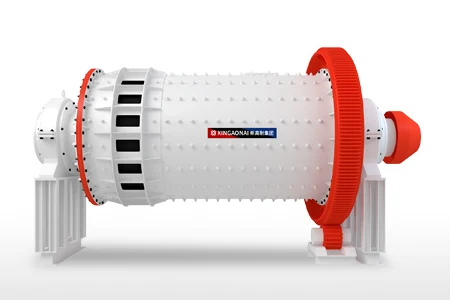
The rod mill working principle is based on the movement of long steel rods inside a rotating cylindrical shell. As the cylinder rotates, the rods are lifted and then roll or cascade downward, reducing the feed material through impact, compression and abrasion.
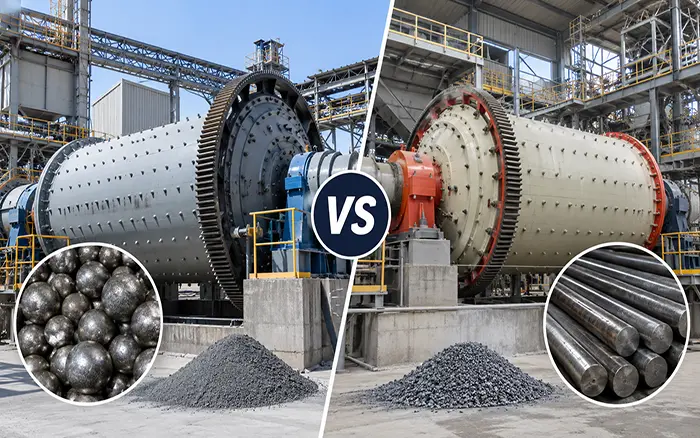
Unlike a ball mill, which uses spherical grinding media, a rod mill uses steel rods that remain approximately parallel to the cylinder axis. This creates more line contact with the feed. Larger particles are more likely to be caught between the rods, which can support controlled coarse grinding and limit unnecessary production of fines under suitable operating conditions.
A simplified rod mill process is:
Pre-crushed feed
       ↓
Controlled feeding
       ↓
Rod lifting, rolling and cascading
       ↓
Impact, compression and abrasion
       ↓
Material moves toward the outlet
       ↓
Discharge
       ↓
Screening or classification
For a broader introduction to the equipment, its types and applications, read What Is a Rod Mill?.
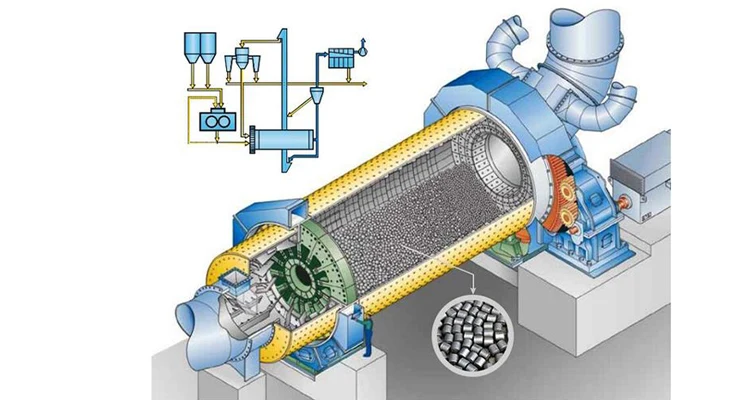
Core Grinding Mechanism of a Rod Mill
Three main forces act on material inside a rod mill.
1. Impact
As the cylinder rotates, the liners and friction lift the rods and material. When gravity overcomes the lifting action, the rods fall or cascade downward.
This movement produces impact that breaks larger feed particles. The intensity of the impact depends on cylinder speed, rod size, rod loading, material level and liner profile.
2. Compression
Particles caught between two rods, or between the rods and the liner, are subjected to compression.
Because the rods provide elongated contact surfaces, larger particles tend to receive more direct compression than particles that can pass through the spaces between the rods. This contributes to the selective grinding behaviour associated with rod mills.
3. Abrasion
Rolling and sliding between the rods, material and liner create abrasion. This action gradually reduces smaller particles and smooths irregular edges.
Actual size reduction results from the combination of impact, compression and abrasion rather than from a single force.
Main Components Supporting the Working Principle
| Component | Function in the grinding process |
|---|---|
| Cylinder | Contains the rods and material and provides the rotating grinding chamber |
| Steel rods | Apply impact, compression and abrasion to the feed |
| Liners | Protect the cylinder and influence rod lifting and movement |
| Feed device | Introduces material into the cylinder at a controlled rate |
| Discharge device | Allows ground material to leave the mill |
| Motor | Provides power for cylinder rotation |
| Reducer | Reduces motor speed and transfers torque |
| Pinion and girth gear | Transmit rotation to the cylinder |
| Bearings or trunnions | Support the rotating mill |
| Lubrication system | Lubricates bearings and drive components |
The liner profile must lift the rods sufficiently to create effective movement without causing excessive impact or unstable rod motion. Worn or unsuitable liners can reduce capacity and change the product-size distribution.
See the rod mill liner guide for liner functions, inspection and replacement considerations.
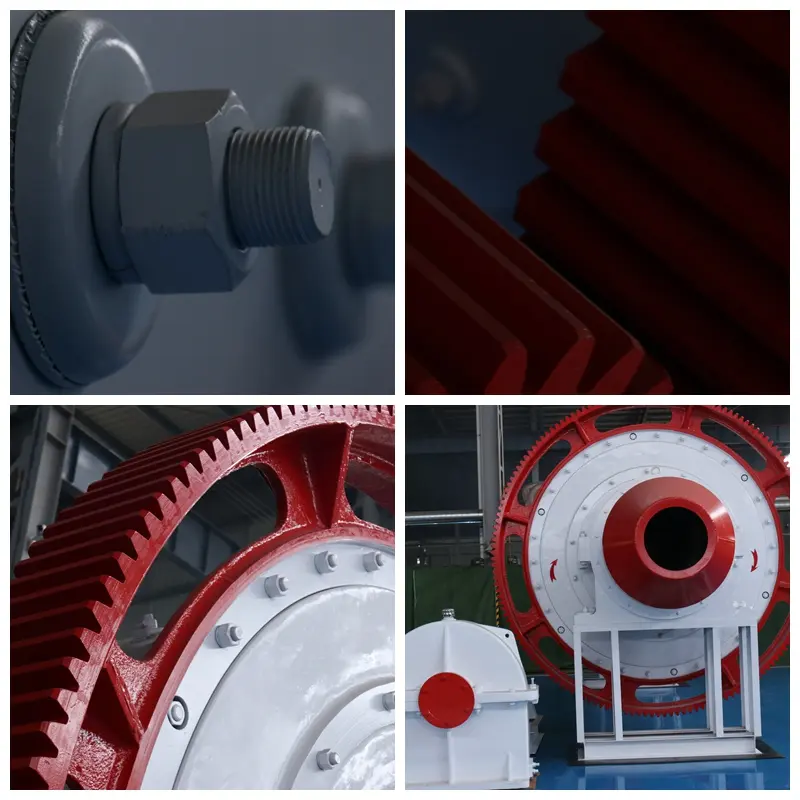
Step-by-Step Rod Mill Working Process
Step 1: Feed preparation
A rod mill is not normally used for primary crushing. Large rocks or ore must first be reduced by upstream crushing equipment.
Feed preparation should control:
Maximum particle size
Particle-size distribution
Moisture or slurry concentration
Clay content
Foreign metal
Feeding consistency
Oversized or inconsistent feed can reduce throughput, increase power fluctuations and accelerate rod and liner wear.
For the current XINGAONAI sand making rod mill range, the published maximum feed size is 30 mm. The appropriate feed condition must still be confirmed for the actual material.
Step 2: Controlled feeding
The prepared material enters through the feeding device. The feed rate should remain as stable as possible.
Underfeeding may leave part of the grinding volume unused and reduce output. Overfeeding can increase the mill load, restrict material movement and produce an excessively coarse discharge.
The feed rate should therefore be adjusted together with motor load, discharge condition and product-size testing.
Step 3: Cylinder rotation
The motor transfers power through the reducer and gear system, causing the cylinder to rotate.
Rotation creates friction between the liner, rods and material. The rods are lifted along the rising side of the cylinder until gravity causes them to roll or cascade downward.
A rod mill should operate below the speed at which the rods would remain against the cylinder wall due to centrifugal force.
Step 4: Rod movement and grinding
As the rods descend, they act on the feed through impact, compression and abrasion.
The rods should remain generally aligned with the cylinder axis. Their movement creates elongated contact zones that preferentially act on larger particles.
This mechanism can reduce overgrinding compared with ball grinding in suitable coarse-grinding duties, but the result depends on proper rod selection and operating conditions.
Step 5: Axial material movement
As new material enters, the internal load gradually moves toward the discharge end.
The speed of this movement—often described as retention time—is affected by:
Feed rate
Mill dimensions
Material level
Slurry concentration in wet operation
Discharge opening
Discharge configuration
A longer retention time generally allows more grinding but may increase fine generation. A shorter retention time may increase throughput but leave excessive coarse material.
Step 6: Discharge
Ground material exits through the mill’s discharge system.
The rod mill itself does not always produce a perfectly classified finished product. A vibrating screen, classifier or another separation device may be required after discharge.
Oversized material can be returned to the mill in a closed circuit, while qualified material continues to the next process or finished-product stockpile.
Why Rotation Speed Matters
Cylinder speed is one of the most important operating variables.
If the speed is too low
The rods may not be lifted high enough to develop effective impact and cascading action. Possible results include:
Low grinding efficiency
Reduced capacity
Coarse product
Unstable material movement
Underuse of installed motor power
If the speed is too high
Excessive centrifugal force can carry the rods too far around the cylinder. Possible results include:
Excessive impact
Higher liner and rod wear
Unstable rod movement
Increased vibration
Risk of rod crossing or tangling
Reduced grinding selectivity
Critical speed
Critical speed is the theoretical cylinder speed at which the grinding media would be held against the mill wall by centrifugal force rather than cascade downward.
A rod mill operates below its critical speed. The correct operating speed is established according to cylinder diameter, rod dimensions, liner design and grinding duty.
For this reason, a single RPM value should not be applied to every rod mill. A larger-diameter mill generally uses a lower rotational speed than a smaller-diameter mill.
How Rod Size and Rod Loading Affect Grinding
Rod diameter
Rod diameter should correspond to the largest particles requiring breakage.
Rods that are too small may not generate sufficient force for coarse feed.
Rods that are too large can increase impact, wear and unnecessary energy use.
A suitable distribution of rod diameters helps maintain grinding performance as the rods wear.
Rod length
Rods are normally slightly shorter than the effective internal length of the cylinder so that they can move without being trapped between the end liners.
Excessively long, bent or heavily worn rods can increase the risk of crossing and tangling.
Rod loading
Insufficient rod loading reduces the available grinding contact and may lower capacity. Excessive loading leaves less space for material movement and may increase power demand and wear.
The correct rod charge should be specified by the manufacturer for the mill dimensions and application. It should be monitored through operating data and periodic inspection rather than estimated from a universal percentage.
Rod wear
During operation, the rods gradually lose diameter and mass. Worn rods should be replenished according to the manufacturer’s procedure.
Broken, bent or abnormally worn rods should be removed because they can disturb rod alignment and damage the liner.
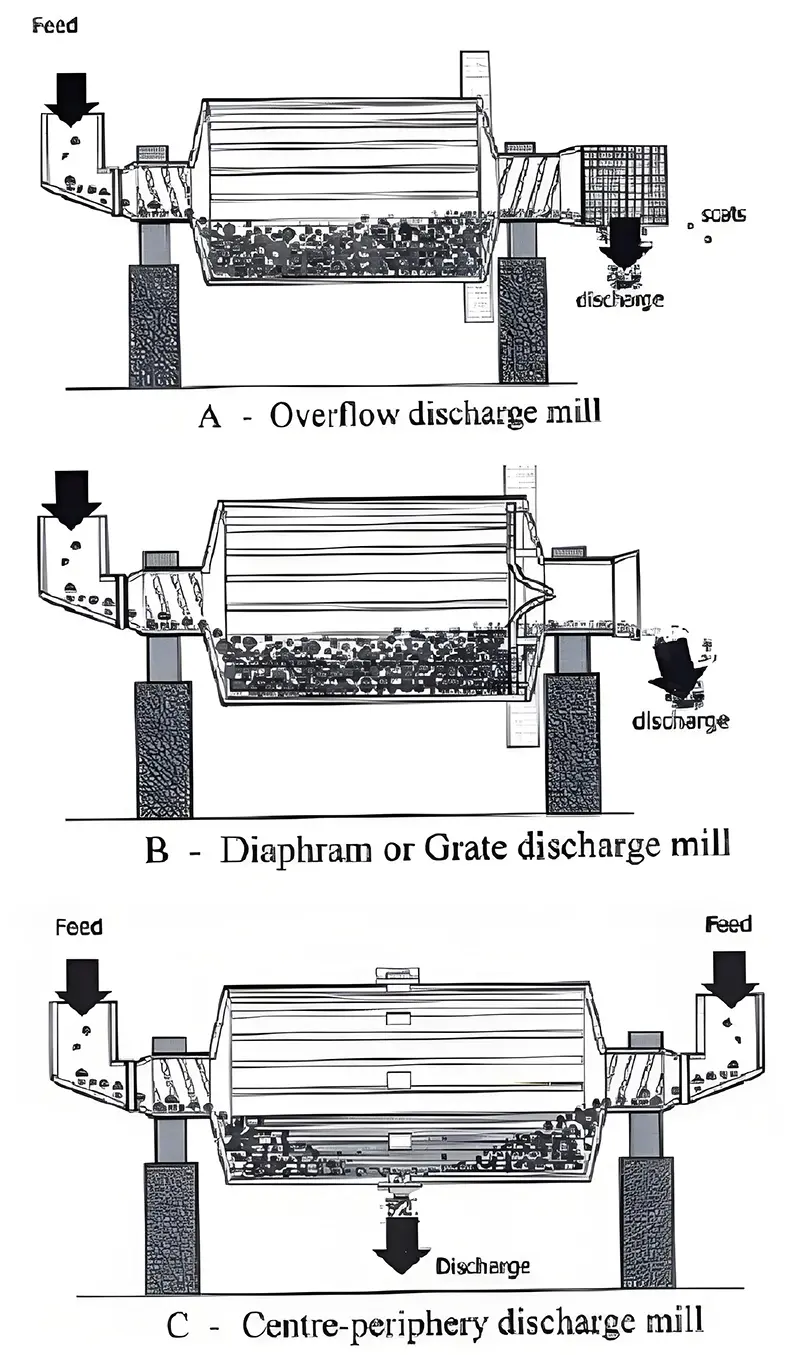
Discharge Methods and Their Effect
Different discharge designs change material retention time, capacity and product size.
Overflow discharge
In an overflow rod mill, slurry exits through the discharge trunnion after reaching the overflow level.
This arrangement is commonly associated with wet grinding. Product size is influenced by the internal slurry level, feed conditions and downstream classification.
End peripheral discharge
Material leaves through openings around the cylinder near the discharge end.
The relatively direct discharge path can reduce retention time and may be considered for coarser grinding or higher-throughput duties.
Center peripheral discharge
Material is commonly fed from both ends and discharged near the center of the cylinder.
This configuration may be selected for coarse grinding and sand-making duties where short material retention and controlled fine generation are required.
No discharge type is universally better. Selection depends on the target product, operating mode, feed material and complete circuit design.
Wet and Dry Rod Mill Operation
The fundamental rod mill working principle remains the same in wet and dry processes, but material transport and auxiliary equipment differ.
Wet operation
Water is added to form a slurry. Wet operation can:
Assist material transport
Reduce airborne dust
Integrate with hydrocyclones or classifiers
Support downstream mineral separation
However, slurry concentration must be controlled. A slurry that is too thick may restrict movement, while excessive dilution may reduce effective grinding contact and increase water-handling requirements.
Dry operation
Material is processed without forming a slurry. Dry operation may be used when a dry product is required or water is unavailable.
It usually requires closer control of:
Feed moisture
Dust collection
Ventilation
Material temperature
Discharge flow
Materials with high moisture or clay content may adhere to rods, liners or discharge openings. Suitability should be confirmed through testing instead of assuming that every rod mill can process sticky feed reliably.
Factors Affecting Rod Mill Capacity and Product Size
| Factor | Possible effect |
|---|---|
| Feed size | Coarser feed generally requires more grinding work |
| Feed-size distribution | Large fluctuations can destabilize load and product size |
| Material hardness | Harder material may reduce capacity and increase wear |
| Abrasiveness | Influences rod and liner consumption |
| Moisture or slurry density | Affects flow, transport and grinding contact |
| Feed rate | Overfeeding produces coarse discharge; underfeeding reduces output |
| Cylinder speed | Controls rod lifting, cascading and impact |
| Rod diameter | Influences the breakage of coarse particles |
| Rod charge | Affects grinding contact, power draw and internal volume |
| Liner condition | Influences rod movement and protects the cylinder |
| Discharge configuration | Affects retention time and throughput |
| Closed-circuit load | Changes the amount of material returned for regrinding |
| Target product size | Finer targets normally require more grinding work |
Capacity figures should always be tied to stated feed and product conditions. Published capacity alone is not sufficient for final model selection.
How the Working Principle Is Used for Sand Making
In a sand-making circuit, the rod mill receives material that has already been reduced by upstream crushers.
The rods act selectively on larger particles, while smaller particles are more likely to pass through the rod charge and move toward the discharge. Under properly controlled conditions, this can help produce a relatively consistent sand-sized product without unnecessarily grinding every particle to a very fine size.
A typical circuit may be:
Crusher
   ↓
Feed bin
   ↓
Controlled feeder
   ↓
Sand making rod mill
   ↓
Vibrating screen
   ↓
Qualified sand + oversize return
Final sand quality still depends on the complete circuit. The rod mill alone cannot guarantee required grading, particle shape, moisture or fines content.
XINGAONAI’s sand making rod mill range lists a maximum feed size of 30 mm, nominal discharge below 5 mm and capacities from 80 to 500 t/h. Actual results depend on the material and operating conditions.
Common Operating Symptoms and Possible Causes
| Symptom | Possible causes |
|---|---|
| Product becomes too coarse | Excessive feed rate, worn rods, low rod loading, low speed or short retention time |
| Excessive fines | Feed rate too low, excessive retention time, unsuitable rods or unnecessary recirculation |
| Capacity decreases | Harder feed, larger feed size, liner wear, blocked discharge or insufficient rod charge |
| Power draw rises | Overfeeding, excessive rod loading, restricted discharge or mechanical resistance |
| Abnormal vibration | Misalignment, foundation problems, gear issues, damaged bearing or uneven internal load |
| Abnormal impact noise | Low material level, oversized feed, unsuitable rod size or loose liner components |
| Rod tangling | Bent or heavily worn rods, unsuitable rod length, unstable operation or incorrect loading |
| Uneven rod wear | Poor alignment, irregular feeding, liner wear or unsuitable operating conditions |
These symptoms can have more than one cause. Operators should check process data, mechanical condition and product-size results before making adjustments.
Rod Mill vs Ball Mill Working Principle
Both machines use a rotating cylinder, but their grinding media create different contact patterns.
| Item | Rod mill | Ball mill |
|---|---|---|
| Grinding media | Long steel rods | Steel or ceramic balls |
| Main contact pattern | More line contact | More point contact |
| Typical duty | Coarse to intermediate grinding | Intermediate to fine grinding |
| Media movement | Rods roll and cascade while remaining generally parallel | Balls cascade, roll and impact in multiple directions |
| Common selection reason | Controlled coarse product and reduced overgrinding | Finer product requirement |
The better machine depends on feed conditions and product targets. Neither working principle guarantees lower energy consumption in every application.
See the full rod mill vs ball mill comparison.
Conclusion
The rod mill working principle combines cylinder rotation with the lifting, rolling and cascading movement of steel rods. Impact breaks larger particles, compression acts on material trapped between rods, and abrasion completes the size-reduction process.
Stable performance depends on maintaining the correct relationship between feed size, cylinder speed, rod specifications, rod loading, liner condition, discharge design and classification circuit.
For equipment selection, provide the material, maximum feed size, required capacity, target product size, moisture and wet or dry process. These conditions are necessary to determine whether a rod mill is suitable and which configuration should be used.