

Working Principle of Mining Vibrating Feeder
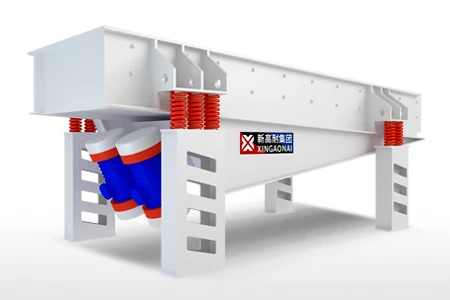
Vibration Generation: The vibration motor is the power source of the mining vibrating feeder. It consists of two eccentric blocks with adjustable angles. When the motor operates, the eccentric blocks rotate at high speed, generating centrifugal force that forms a reciprocating vibration force in the horizontal and vertical directions.
Material Movement: The vibration force is transmitted to the feed trough, causing the trough to vibrate periodically. Under the action of this vibration, the bulk materials in the trough are thrown upward and forward in a parabolic trajectory continuously.
Uniform Feeding: By adjusting the amplitude (via the angle of the eccentric blocks) and the speed of the vibration motor, the feeding rate of the mining vibrating feeder can be precisely controlled. This ensures that materials are fed into the downstream equipment (such as jaw crushers, cone crushers) at a uniform and stable rate, avoiding overload or underload of the crushing equipment.
Key Types of Mining Vibrating Feeder
Electromagnetic Mining Vibrating Feeder: This type uses an electromagnetic vibrator as the vibration source. It features stepless adjustable feeding rate, high feeding precision, and low noise. Suitable for feeding fine-grained and medium-grained materials (feed size ≤500mm) in small to medium-scale mining and aggregate lines. Common models include GZ series electromagnetic vibrating feeders.
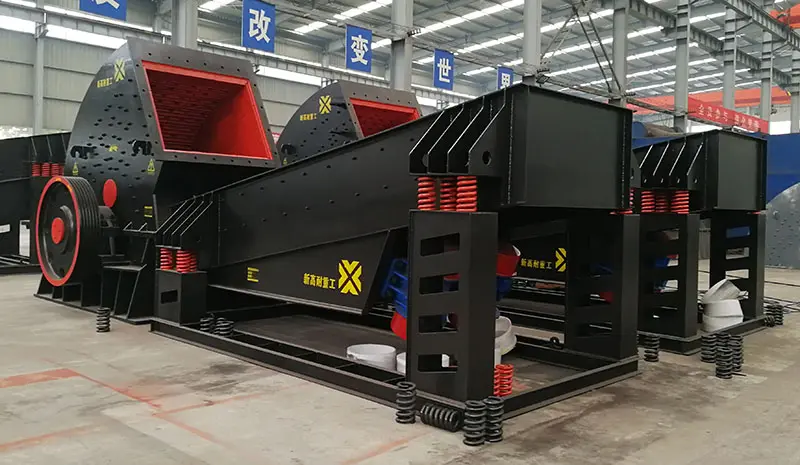
Motor-Driven Vibrating Feeder (Mechanical Vibrating Feeder): Equipped with a vibration motor (as described in the working principle), this is the most widely used type of mining vibrating feeder. It has a simple structure, high reliability, and strong adaptability to harsh working conditions. It can handle large feed sizes (up to 1200mm) and high-capacity feeding (up to 1000 t/h). The ZSW series is a typical representative of motor-driven mining vibrating feeders, widely used in large-scale open-pit mines and aggregate production lines.
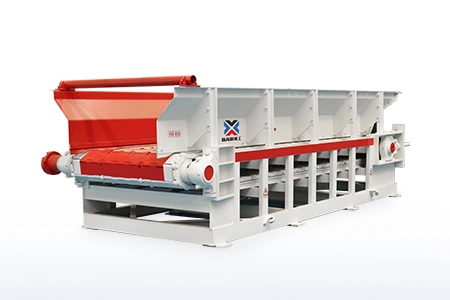
Heavy-Duty Mining Vibrating Feeder: Designed for large-scale mining projects, this type has a robust structure, thickened feed trough, and high-strength vibration motor. It can handle extra-large and heavy bulk materials (such as large ore blocks with feed size ≥1000mm) and operate continuously under high-intensity working conditions. It is often used in the front-end of large crushing lines in metal mines and coal mines.
Linear Vibrating Feeder for Mining: The vibration trajectory of the feed trough is linear, ensuring more uniform material feeding and longer service life of the trough. It is suitable for scenarios where materials need to be transported over a long distance while feeding, such as in continuous production lines of cement plants and metallurgical enterprises.
Applications of Mining Vibrating Feeder
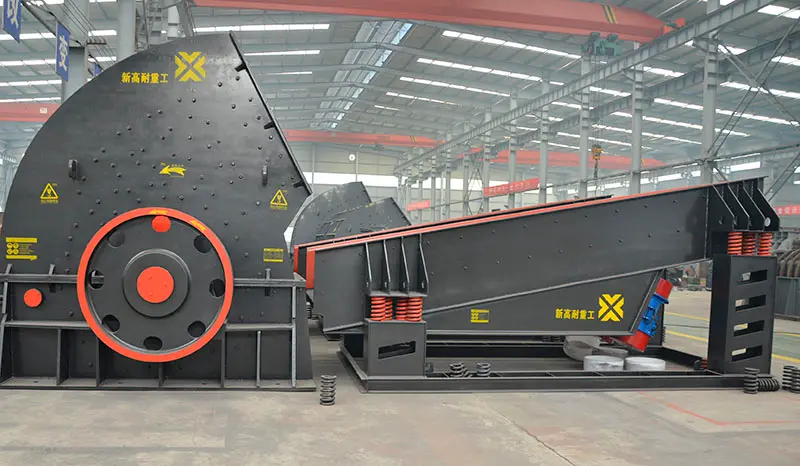
Mining Industry: This is the primary application field of mining vibrating feeders. In metal mines (iron ore, copper ore, gold ore) and non-metal mines (limestone, granite, gypsum), the mining vibrating feeder transports raw ore from the hopper or silo to the primary crusher uniformly. It ensures that the crusher operates under optimal load, improving crushing efficiency and reducing equipment wear. For example, in open-pit iron ore mines, ZSW series mining vibrating feeders are often matched with large jaw crushers to form a stable front-end feeding system.
Aggregate Production Industry: In aggregate production lines for construction, highway, and railway projects, the mining vibrating feeder feeds limestone, river pebbles, and other raw materials into crushing and screening equipment. It ensures the continuous and stable operation of the production line, improving the quality and output of aggregates. The electromagnetic mining vibrating feeder is often used in small to medium-scale aggregate plants due to its precise feeding control.
Coal Processing Industry: In coal mines and coal washing plants, the mining vibrating feeder transports coal from the mine car or silo to the crusher, screen, or conveyor belt. It has good adaptability to coal with high moisture content and can avoid material blockages. Heavy-duty mining vibrating feeders are widely used in large coal-fired power plants and coal chemical projects.
Metallurgical & Chemical Industry: In metallurgical enterprises, the mining vibrating feeder feeds iron ore concentrate, steel slag, and other materials into smelting or processing equipment. In chemical plants, it is used to transport gypsum, salt, and other chemical raw materials. The linear vibrating feeder is preferred in these fields due to its uniform feeding and long-distance transportation capabilities.
Construction Waste Recycling Industry: With the promotion of environmental protection policies, mining vibrating feeders are increasingly used in construction waste recycling lines. They feed concrete blocks, bricks, and other construction waste into crushing equipment, realizing resource recycling. The motor-driven mining vibrating feeder is suitable for this field due to its strong anti-wear performance and adaptability to complex materials.
Key Parameters of Mining Vibrating Feeder (Selection Basis)
Feeding Capacity (t/h): This is the core parameter that determines the adaptability of the mining vibrating feeder to the production line. The feeding capacity should be 10-20% higher than the processing capacity of the downstream crushing equipment to avoid production bottlenecks. For example, if the downstream jaw crusher has a processing capacity of 200 t/h, a mining vibrating feeder with a feeding capacity of 220-240 t/h should be selected.
Maximum Feed Size (mm): This parameter indicates the maximum particle size of the material that the feeder can handle. It should be matched with the particle size of the raw material. If the raw material particle size exceeds the specified maximum feed size, it will cause blockages and damage to the feed trough. Common maximum feed sizes of mining vibrating feeders range from 300mm to 1200mm.
Vibration Frequency & Amplitude: Vibration frequency (Hz) and amplitude (mm) determine the feeding speed and material flow state. High frequency and small amplitude are suitable for fine-grained materials, while low frequency and large amplitude are suitable for coarse-grained and heavy materials. The parameters can be adjusted according to the material characteristics and feeding requirements.
Motor Power (kW): The motor power determines the vibration force of the mining vibrating feeder. Larger motor power is required for handling heavy materials and high-capacity feeding. The motor power ranges from 1.5kW for small electromagnetic feeders to 45kW for large heavy-duty feeders.
Feed Trough Dimensions (Length × Width, mm): The length and width of the feed trough affect the material storage capacity and feeding uniformity. Longer troughs are suitable for long-distance transportation, while wider troughs are suitable for large-volume materials.
Selection Guidelines for Mining Vibrating Feeder
Match with Material Characteristics: For fine-grained (≤200mm) and dry materials, select an electromagnetic mining vibrating feeder for precise feeding control. For coarse-grained (≥500mm), heavy, or wet materials, choose a motor-driven or heavy-duty mining vibrating feeder with strong anti-wear and anti-blocking performance.
Align with Production Capacity: Calculate the required feeding capacity based on the downstream equipment's processing capacity and production line output. Avoid selecting a feeder with excessive or insufficient capacity to ensure production efficiency and cost-effectiveness.
Consider Working Conditions: For harsh working conditions (high temperature, high humidity, dusty environments), select a mining vibrating feeder with a sealed motor and corrosion-resistant feed trough. For outdoor operations, choose equipment with weather-resistant paint and waterproof components.
Focus on Equipment Reliability & Maintenance: Select models with mature technology, simple structure, and easy maintenance. Prioritize manufacturers that provide complete after-sales service and spare parts supply to reduce downtime due to equipment failures.
Check Compatibility with Production Line: Ensure the overall dimensions and installation method of the mining vibrating feeder match the existing production line layout. The feeding height and discharge position should be aligned with the downstream equipment to avoid material spillage and transportation obstacles.
Maintenance Tips for Mining Vibrating Feeder
Regular Inspection: Daily inspect the vibration motor, elastic support, feed trough, and fasteners. Check for loose bolts, abnormal noise, and excessive vibration. Timely tighten loose parts and replace damaged components.
Lubrication Maintenance: Regularly lubricate the bearing of the vibration motor with high-quality lubricating oil. The lubrication frequency should be determined according to the operating time and working environment (usually once every 1-3 months).
Clean the Feed Trough: After daily operation, clean the residual materials in the feed trough to avoid material caking and corrosion. For materials with high moisture content, use a high-pressure water gun to clean the trough.
Adjust Vibration Parameters: Periodically check and adjust the angle of the eccentric blocks to ensure the feeding rate meets the production requirements. If the feeding is uneven, adjust the amplitude or vibration frequency in time.
Prevent Overload Operation: Avoid feeding materials exceeding the maximum feed size or feeding rate to prevent damage to the vibration motor and feed trough. Install a material level sensor to monitor the material amount in the trough and realize automatic feeding control.