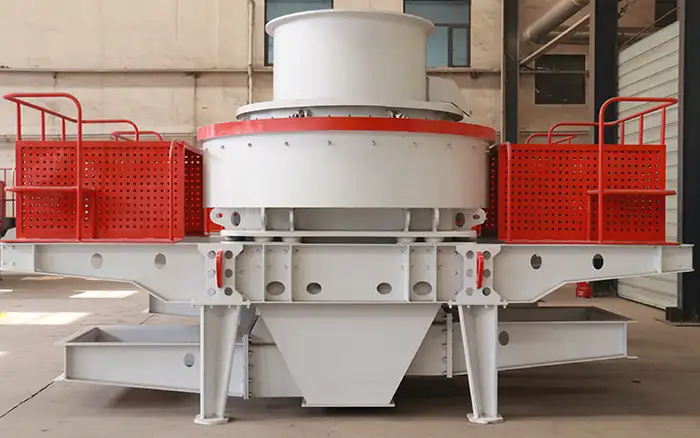
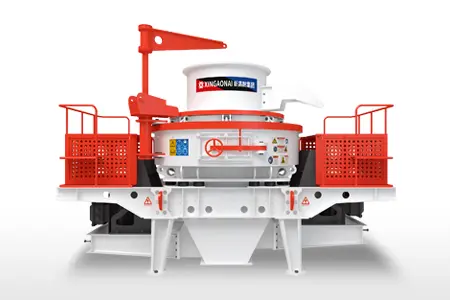
The vertical shaft impact crusher working principle is based on accelerating material through a high-speed vertical rotor and then using impact energy to break or reshape the particles.
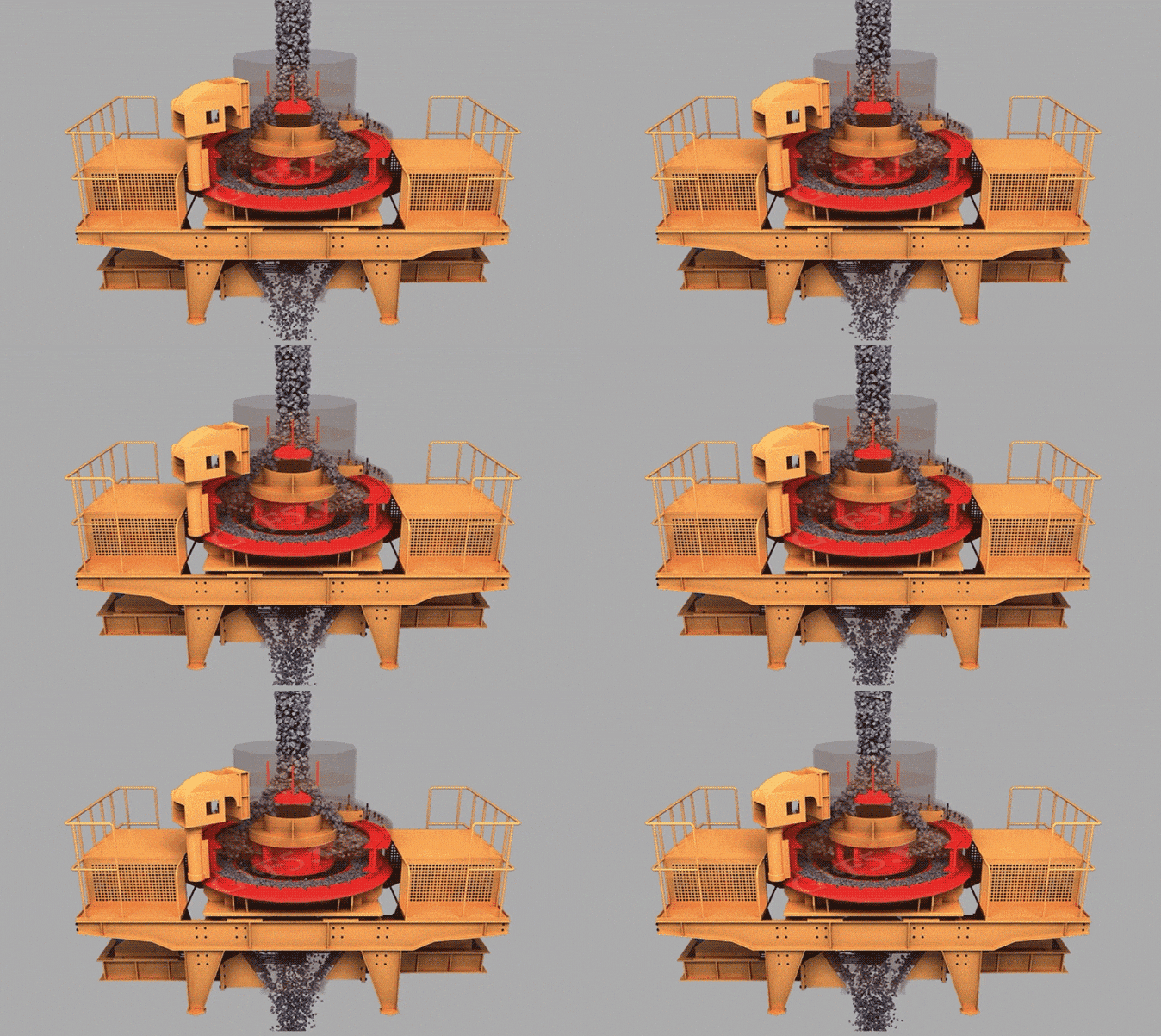
Material entering the crusher is distributed toward the rotor. The rotor accelerates the particles and discharges them through its ports into the crushing chamber. Depending on the chamber configuration, the particles collide with a retained rock bed, metal anvils or other moving particles.
The operating sequence can be summarized as:
Controlled Feed → Rotor Acceleration → High-Speed Impact → Particle Breakage and Shaping → Discharge
Unlike jaw and cone crushers, which mainly use compression, a VSI crusher uses particle velocity and impact as its principal source of crushing energy.
This makes a VSI particularly useful for:
Manufactured-sand production
Final-stage fine crushing
Aggregate shaping
Reducing elongated or flaky particles
Processing pre-crushed hard rock
Producing controlled fine aggregate
However, a VSI is normally a tertiary or final-stage crusher. It generally requires material that has already been reduced by upstream equipment.
What Is a Vertical Shaft Impact Crusher?
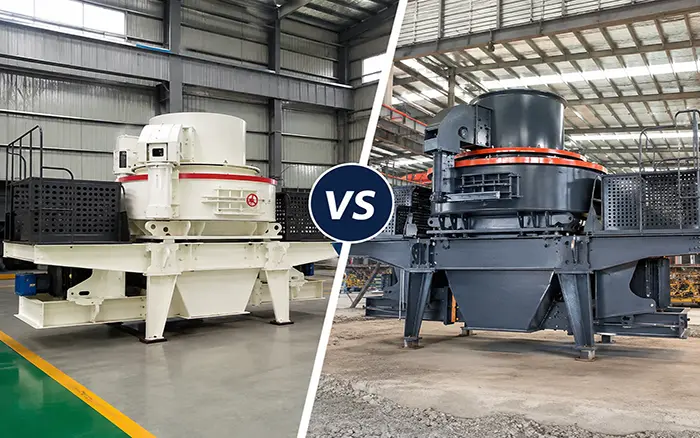
A vertical shaft impact crusher, commonly called a VSI crusher, is an impact-crushing machine built around a vertically arranged rotor.
The rotor receives mechanical power from the motor and transfers that energy to the feed material. As the rotor turns, material entering the rotor is accelerated and discharged outward into the crushing chamber.
The principal difference between a VSI and a horizontal-shaft impact crusher is the rotor orientation and material-flow direction.
| Crusher | Rotor or crushing movement | Main crushing force | Typical role |
|---|---|---|---|
| Jaw crusher | Reciprocating jaw | Compression | Primary crushing |
| Cone crusher | Gyrating mantle | Compression | Secondary or tertiary crushing |
| Horizontal impact crusher | Horizontal rotor and blow bars | Direct impact | Secondary crushing |
| VSI crusher | Vertical high-speed rotor | Accelerated-particle impact | Tertiary crushing and shaping |
The XINGAONAI VSI vertical shaft impact crusher is intended for manufactured-sand production, fine crushing and aggregate shaping. The current product range lists feed sizes up to 60 mm and capacities from 70 to 640 t/h, depending on the model and feeding method.
These figures are model ranges, not guaranteed output for every material.
Main Components of a VSI Crusher
Understanding the working principle requires distinguishing the actual crusher components from external production-line equipment.
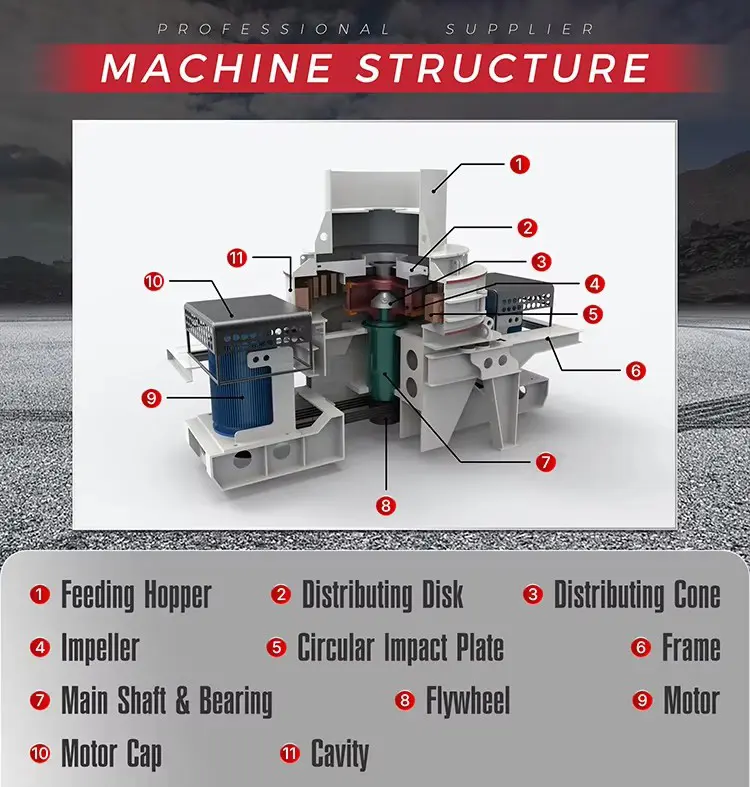
Feed hopper
The feed hopper receives prepared material from the upstream conveyor or feeder.
Its purpose is to guide the material toward the distribution and feeding area. It does not normally regulate the entire production line by itself, so stable upstream feeding is still required.
Feed tube
The feed tube directs material toward the central feeding area or rotor.
Because feed continuously passes through this component, its wear condition should be inspected regularly. A worn or incorrectly positioned feed tube can disturb material distribution.
Feed distributor
The distributor controls how material enters the rotor or crushing chamber.
Depending on the machine configuration, it may direct the feed primarily toward the rotor or divide part of the feed into a surrounding material stream.
Rotor
The rotor is the principal operating component.
It rotates around a vertical shaft and accelerates the material before discharging it through the rotor ports.
Rotor design influences:
Material acceleration
Feed capacity
Particle trajectory
Wear-part distribution
Crushing-chamber loading
Product characteristics
Rotor tips and wear plates
Rotor tips and internal wear plates protect the rotor at high-wear positions.
Their condition affects:
Rotor balance
Particle discharge direction
Crushing efficiency
Vibration
Wear on surrounding components
Wear parts should normally be replaced in balanced sets according to the equipment manual.
Crushing chamber
The crushing chamber surrounds the rotor and provides the area where impact and particle collision occur.
It may contain:
A retained rock bed
Metal anvils
Impact components
Replaceable liners
Material-distribution structures
The selected chamber configuration determines whether the machine primarily operates in rock-on-rock or rock-on-metal mode.
Main shaft and bearing assembly
The main shaft supports the rotating assembly, while the bearings allow the rotor to operate at the required speed.
Bearing temperature, lubrication condition and vibration should be monitored because an imbalance or lubrication problem can cause serious equipment damage.
Discharge area
After impact crushing, material falls from the crushing chamber and leaves through the lower discharge area.
The crusher does not normally classify the finished product internally. A downstream screen is required to separate qualified material from oversized particles.
Vertical Shaft Impact Crusher Working Principle Step by Step
Step 1: Prepared Material Enters the Crusher
Material enters through the feed hopper and feed tube.
The feed should already be within the allowable size for the selected model and material. A VSI should not normally receive unprocessed quarry-sized rock directly.
Upstream equipment may include:
Jaw crusher
Cone crusher
Impact crusher
Vibrating screen
The upstream screen is especially important because it can remove qualified particles and prevent oversized material from entering the VSI.
Step 2: Material Is Distributed
The feed-distribution system directs material into the rotor or divides it between different flow paths, depending on the machine configuration.
Uniform material distribution helps maintain:
Stable rotor loading
Consistent motor current
Balanced wear
Predictable product quality
Stable production capacity
Uneven feeding can cause one side of the rotor to wear faster than the other.
Step 3: The Rotor Accelerates the Material
The motor drives the vertical rotor at the speed specified for the model and application.
Material entering the rotor travels outward and is accelerated before leaving the rotor ports.
Rotor speed should not be treated as one fixed value for every VSI. XINGAONAI’s current model table lists different operating-speed ranges across the product series, approximately 900–1,900 r/min.
The correct speed depends on:
Rotor diameter
Machine model
Material properties
Required product size
Desired particle shape
Crushing-chamber configuration
Increasing speed generally increases impact energy, but it can also increase fines production, energy consumption and wear.
Step 4: Accelerated Particles Enter the Crushing Chamber
After leaving the rotor, the particles move into the surrounding crushing chamber.
They may collide with:
A retained bed of rock
Stationary metal anvils
Other high-speed particles
Material entering through a secondary flow path
These collisions convert particle velocity into crushing energy.
The particles can fracture through a combination of:
Direct impact
Particle-to-particle collision
Shearing
Abrasion
Fracture along natural weaknesses
The relative importance of each mechanism depends on the material and chamber configuration.
Step 5: Crushing and Particle Shaping Occur
The initial impact reduces particle size. Repeated collisions can then remove weak corners and edges.
This process can help improve particle shape, but the final result depends on:
Original particle shape
Material mineralogy
Feed-size distribution
Rotor speed
Feed rate
Chamber configuration
Recirculating load
Wear-part condition
A VSI does not automatically produce identical cubical particles from every type of stone.
Step 6: Material Leaves the Crusher
After losing velocity, the processed material falls through the lower discharge area.
It is then transported to a vibrating screen.
The screen separates:
Finished manufactured sand
Other qualified aggregate fractions
Oversized material requiring additional crushing
Oversized particles may return to the VSI, forming a closed circuit.
Rock-on-Rock Crushing Mode
In rock-on-rock operation, accelerated material collides with a retained bed of material inside the crushing chamber.
The rock bed acts as the principal impact surface.
How it works
Material enters the rotor.
The rotor accelerates and discharges the particles.
The particles strike the retained rock bed.
Particle-to-particle impact causes breakage.
Repeated collisions contribute to size reduction and shaping.
Potential advantages
Reduced direct contact with some metal components
Suitable for particle-to-particle crushing
Can help improve aggregate shape
May reduce metal wear under appropriate conditions
Limitations
Requires a stable material bed
Feed distribution must remain consistent
Underfeeding can expose internal metal components
Product and capacity depend on the material
The rock bed must be inspected during operation
Rock-on-rock mode does not mean that the machine experiences no wear. Rotor tips, feed components and other internal parts still require inspection and replacement.
Rock-on-Metal Crushing Mode
In rock-on-metal operation, material discharged from the rotor strikes stationary metal anvils or impact components.
How it works
The rotor accelerates the feed.
Particles leave the rotor ports.
The particles strike stationary metal surfaces.
Direct impact produces size reduction.
Processed material falls toward the discharge.
Potential advantages
More aggressive direct-impact action
May provide greater size reduction under suitable conditions
Useful when crushing is more important than minimizing metal contact
Limitations
Greater wear on metal impact components
Wear cost can rise with abrasive material
Worn anvils can change product size and crushing performance
Wear must be monitored to maintain consistent operation
Rock-on-metal should not automatically be described as better for all hard materials. The correct mode depends on material abrasiveness, required reduction and acceptable wear cost.
Rock-on-Rock vs Rock-on-Metal
| Factor | Rock-on-rock | Rock-on-metal |
|---|---|---|
| Main impact surface | Retained material bed | Metal anvils or impact parts |
| Main interaction | Particle-to-particle | Particle-to-metal |
| Metal wear | Generally lower under suitable conditions | Generally higher |
| Crushing action | Material-bed impact | More direct impact |
| Product result | Often selected for shaping | Often selected for stronger reduction |
| Main requirement | Stable rock bed and feed | Wear-resistant impact components |
| Selection basis | Product shape and wear balance | Reduction and capacity requirements |
The table provides general guidance. Actual performance depends on the specific VSI design and operating conditions.
Center Feeding and Combined Feeding
VSI crushers may use different feeding arrangements, depending on their design.
Center feeding
In center-feeding operation, most or all material enters the rotor.
The rotor accelerates the material before it enters the crushing chamber.
This configuration emphasizes high-speed impact and may be selected when greater fine crushing or shaping action is required.
Combined or cascade feeding
In a combined-feed arrangement, part of the material enters the rotor while another part bypasses the rotor and enters the surrounding crushing area.
The accelerated rotor stream then collides with the surrounding material stream.
This arrangement may increase total throughput, but the final result depends on:
Feed split
Feed grading
Rotor capacity
Required reduction
Product-shape target
Chamber configuration
The terminology and adjustment method can differ between manufacturers. Operators should follow the model-specific manual rather than applying a general feed split.
Factors Affecting VSI Crusher Performance
Feed size
Oversized material increases rotor loading, blockage risk and impact on wear parts.
The maximum permissible feed may also be smaller for hard material than for softer material.
Feed-size distribution
A controlled distribution normally provides more stable operation than material containing unpredictable oversized rocks or excessive fines.
Rotor speed
Higher speed generally increases particle velocity and impact energy.
However, it may also:
Produce more fines
Increase power consumption
Accelerate rotor-tip wear
Increase sensitivity to imbalance
Rotor speed should be adjusted within the manufacturer’s permitted range.
Feed rate
Overfeeding can reduce acceleration per particle, overload the machine or cause blockage.
Severe underfeeding may reduce production and disturb the protective material bed in rock-on-rock operation.
Material abrasiveness
Quartz-rich granite, basalt and other abrasive rocks can increase wear on rotor tips, liners and anvils.
Wear cost should be considered during machine and chamber selection.
Moisture and clay
Excessive moisture combined with clay or sticky fines can cause material accumulation in the feed tube, rotor or discharge area.
Moisture should therefore be considered together with clay content rather than using one universal moisture limit.
Wear-part condition
Worn rotor tips, feed tubes, anvils or liners change material trajectory and can reduce product consistency.
Uneven wear can also produce rotor imbalance and abnormal vibration.
Downstream screening
An inefficient screen can return too much material or allow oversized particles into finished products.
The VSI and screen should be treated as one closed-circuit system when consistent product grading is required.
Common VSI Operating Problems
| Problem | Possible causes | Checks |
|---|---|---|
| Abnormal vibration | Uneven feeding, rotor imbalance, uneven wear, loose components | Stop safely and inspect feed distribution, rotor and fasteners |
| Capacity decreases | Restricted feed, worn rotor parts, blockage, incorrect feed grading | Check feeder, feed tube, rotor and discharge |
| Excessive fines | Rotor speed too high, excessive recirculation, unsuitable feed | Check speed, screen and return load |
| Poor particle shape | Unstable feed, worn parts, low impact energy, unsuitable chamber | Check feed consistency, rotor speed and wear |
| Wear rate increases | Abrasive feed, oversized material, incorrect chamber or speed | Check feed size, mineralogy and wear configuration |
| Motor current fluctuates | Uneven feeding, intermittent blockage or variable feed size | Check feeder and material flow |
| Discharge blocks | Sticky feed, excessive moisture, foreign material or restricted outlet | Stop, isolate and inspect the discharge area |
| Product becomes coarser | Worn rotor tips, reduced speed or changed feed | Check wear, motor drive and feed conditions |
Before opening the machine, stop the motor, isolate the electrical supply and confirm that the rotor has completely stopped.
VSI Crusher Maintenance Points
Daily checks
Monitor vibration and operating sound.
Record motor current.
Inspect feed stability.
Check for material accumulation.
Observe discharge flow.
Monitor bearing temperature where instrumentation is available.
Regular internal inspection
Inspect:
Feed tube
Distributor
Rotor tips
Rotor wear plates
Anvils or rock-bed condition
Chamber liners
Fasteners
Discharge area
Balanced wear-part replacement
Rotor wear parts should be replaced according to the model manual and in a way that maintains rotor balance.
Replacing only one severely worn component without balancing the rotor may cause vibration.
Lubrication
Use the lubricant, quantity and interval specified by the manufacturer.
Over-lubrication, insufficient lubrication and contamination can all affect bearing life.
Feed control
Prevent metal, oversized rock and other uncrushable objects from entering the machine. Upstream screening and metal removal should be considered where required.
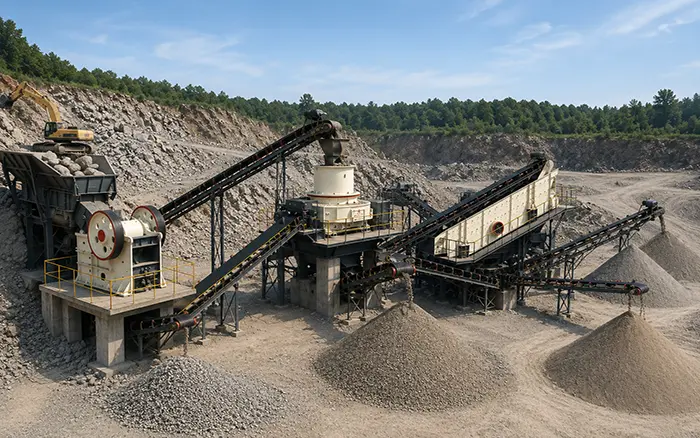
Where Does a VSI Fit in a Sand-Making Plant?
A common configuration is:
Feeder → Jaw Crusher → Cone or Impact Crusher → Screen → VSI Crusher → Final Screen
The VSI normally performs the final crushing or shaping duty.
It should not be expected to replace every upstream crusher.
For equipment combinations based on different raw materials, see the stone crusher and sand making machine configuration guide.
For the complete production sequence, including washing and classification, see the stone-to-sand process.
Readers looking for the differences between VSI, rotor and roller machines should instead read how different sand making machines work.
Information Needed Before Selecting a VSI
Provide the following information:
Raw material
Maximum feed size
Feed-size distribution
Material hardness
Abrasiveness or silica content
Moisture and clay content
Required hourly capacity
Required finished-product sizes
Required manufactured-sand proportion
Particle-shape requirement
Existing upstream crushers
Existing screen configuration
Dry or wet process
Project location and power supply
The appropriate rotor, chamber, feed mode and model should be determined from these conditions.
Conclusion
The vertical shaft impact crusher working principle uses rotor acceleration and high-speed impact to reduce and reshape prepared material.
Material enters the feed system, is accelerated by the vertical rotor and then collides with a rock bed, metal anvils or other particles. The crushed material leaves through the lower discharge and is normally classified by a downstream screen.
VSI performance depends on more than rotor speed. Feed size, feed grading, material abrasiveness, feed rate, chamber configuration, moisture, wear-part condition and downstream screening all influence capacity and product quality.
A VSI should therefore be selected and adjusted as part of the complete crushing and screening circuit rather than as an isolated machine.