Choosing a bentonite grinding mill involves more than matching a mesh number to an hourly capacity. Feed moisture, material handling, particle-size requirements and the intended application all influence whether a grinding system can produce a consistent finished powder.
Although bentonite is relatively soft, it can still be difficult to process. Moist material may adhere to equipment surfaces, form agglomerates or interrupt feeding. These problems can restrict production even when the mill has sufficient installed power.
The practical starting point is to define the required product, understand the incoming material and evaluate the complete grinding circuit. A capacity figure without those conditions is not enough to establish suitability.
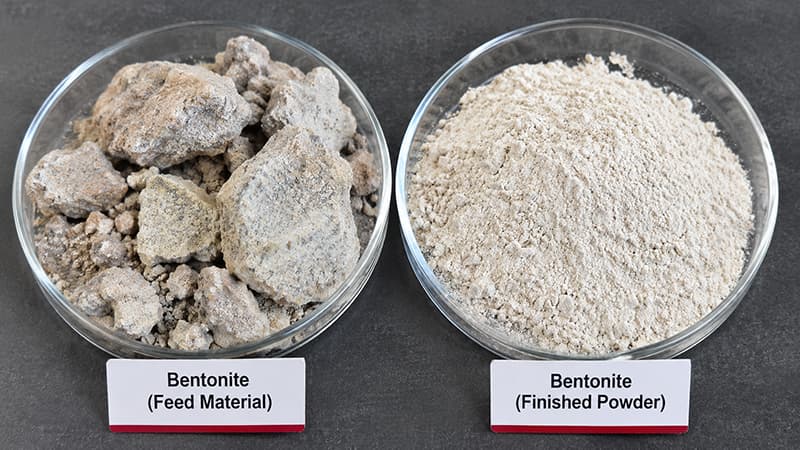
What Makes Bentonite Grinding Different?
Bentonite is a clay material whose processing behavior depends on its mineral composition, condition and intended use. Its response to water, swelling behavior and bonding properties can be important to the finished product.
For a grinding plant, this creates two separate requirements: the material must move reliably through the equipment, and the powder must satisfy its application specification.
Potential difficulties include:
Moist feed sticking to hoppers, chutes or internal surfaces.
Agglomerated material causing irregular feeding.
Changes in feed condition affecting grinding and classification.
Powder meeting a fineness target but failing the required application tests.
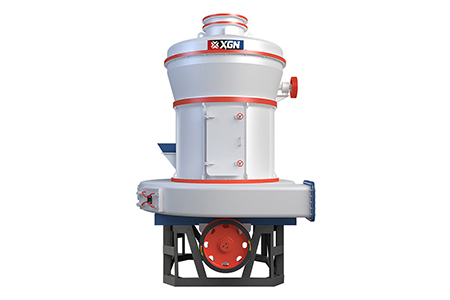
For dry bentonite powder production, a Raymond mill can be considered when the prepared feed, moisture conditions and required particle-size distribution are compatible with the selected system. Its suitability should be evaluated against the actual material and finished-product requirements.
The process route also depends on the product form. A granular bentonite product may require a different preparation route from a fine powder.
Define the Finished Product Before Selecting the Mill
Start with the finished-product specification rather than the equipment model. Fineness matters, but it does not describe the complete product requirement.
| Requirement | What should be defined |
|---|---|
| Product form | Powder or granules with specified characteristics |
| Particle size | Sieve limits or a defined particle-size distribution |
| Product moisture | Required range and measurement method |
| Application performance | Relevant tests for the intended use |
| Consistency | Permitted variation between samples or production batches |
| Finished output | Required production rate while meeting the specification |
A request for “200 mesh bentonite,” for example, needs clarification. The specification should identify the sieve opening, the required passing percentage or permitted residue, and the test method.
Similarly, D50 and D97 should be accompanied by the measurement method and whether the distribution is reported on a mass or volume basis. These values should not be treated as direct substitutes for a mesh specification.
Producing a finer powder is not automatically an improvement. The target should be the particle-size distribution and application performance required by the customer.
Feed Moisture and Drying Requirements
Measure Moisture at the Relevant Process Location
Moisture results are only useful when the sampling location is identified. A stockpile sample does not necessarily represent the material entering the mill.
Useful sampling locations include:
As-received material or the stockpile.
Material after drying or conditioning.
The mill inlet.
Finished powder before storage or packing.
Seasonal changes, storage conditions and material blending can affect these results. Record the sampling location and method so that comparisons are meaningful.
Decide Whether Feed Preparation Is Necessary
The need for drying depends on the actual feed condition and the operating limits of the selected system. Some materials may require blending, lump preparation or drying before they can be fed consistently.
The EPA’s clay-processing overview describes drying followed by grinding as one bentonite processing route. It provides process background, rather than operating settings for every modern grinding system.
Do not assume that every Raymond mill includes a drying function. Where drying is required, the heat source, controls and drying capacity need to be evaluated as part of the complete installation.
Control Drying Against Product Requirements
Drying should prepare the material for reliable processing while preserving the properties required of the finished product.
Drying-gas temperature, material temperature and residence time are different variables. A gas temperature quoted for another installation should not be adopted as the material-temperature limit for a new project.
Establish suitable conditions for the actual bentonite and verify the resulting moisture and application performance.
When Can a Raymond Mill Be Considered?
A Raymond mill can be evaluated for dry bentonite powder production when the feed preparation, target fineness and required output are compatible with the proposed configuration.
In a suitable grinding circuit:
Prepared material enters the mill at a controlled rate.
Grinding components reduce the material size.
Air carries the ground material toward the classifier.
Material meeting the classification target proceeds to collection.
Rejected coarse material returns for further grinding.
The mill, feeder, classifier, fan, collector and discharge equipment must work together. Installing a larger main mill will not necessarily solve a restriction caused by sticky feed, inadequate airflow or poor powder discharge.
A general equipment capacity range should not be presented as confirmed bentonite output. Performance needs to be established for the specified feed, finished powder and operating conditions.
Why Bentonite Powder Output Can Become Unstable
A fall in output does not necessarily mean that the main mill is too small. Feed preparation and the supporting equipment should also be checked.
| Observed problem | Initial checks |
|---|---|
| Feed rate fluctuates | Hopper bridging, sticky deposits, lumps and feeder operation |
| Material accumulates in chutes | Moisture, adhesion, chute condition and outlet restrictions |
| Finished output falls | Feed condition, grinding components, classification and airflow |
| Product becomes coarser | Feed changes, wear, classifier condition and settings |
| Collection or discharge becomes irregular | Deposits, air-system condition, filter condition and discharge restrictions |
These checks are starting points for investigation, rather than proof of a specific fault.
Uneven Feeding
Intermittent feed changes the material load inside the mill. Before changing the grinding settings, inspect the hopper, feeder and transfer points for inconsistent delivery.
Adhesion and Agglomeration
Moisture-related deposits can reduce the effective opening of chutes and interfere with material movement. Agglomerates can also make the feed less consistent.
The response should address the cause of the buildup, rather than relying only on repeated clearing.
Grinding-Component Condition
Worn or damaged grinding components can affect size reduction and consistency. The Raymond mill parts guide explains the functions of the main components.
Assess wear against the equipment manufacturer’s inspection criteria. A change in powder quality should not automatically be attributed to one component without checking the rest of the circuit.
Airflow and Collection Restrictions
Air transport, classification, collection and discharge are connected. Restrictions in one section can affect the operation of the others.
Use the equipment manual and comparable operating records when investigating changes. Stop and isolate the equipment before internal inspection or maintenance.
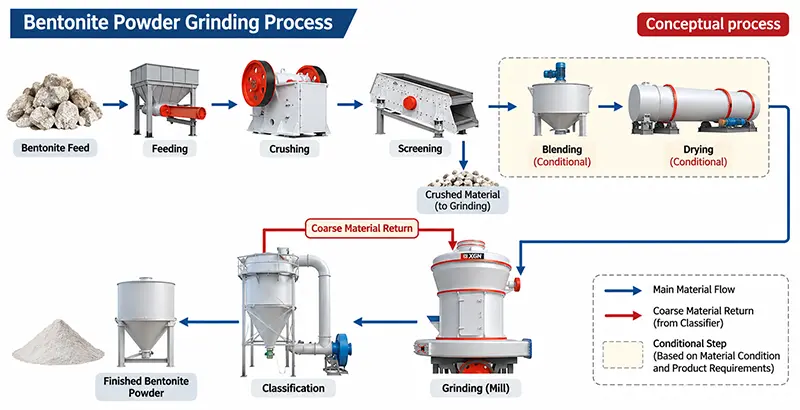
A Typical Bentonite Powder Process
A conceptual dry-powder route is:
Feed assessment and blending where needed → Size preparation → Drying where needed → Controlled feeding → Grinding → Classification → Collection → Storage or packing
Coarse material rejected by the classifier returns to grinding.
| Process step | Main purpose |
|---|---|
| Feed assessment and blending | Understand variation and improve feed consistency where necessary |
| Size preparation | Prepare lumps for the selected downstream equipment |
| Drying, where required | Bring feed into a suitable condition for the proposed system |
| Controlled feeding | Maintain a consistent material supply |
| Grinding | Reduce particle size |
| Classification | Separate material according to the specified size target |
| Collection | Recover powder from the conveying air |
| Storage or packing | Handle the finished product while controlling contamination and moisture exposure |
This is a conceptual route, not a fixed equipment list. Activation, purification and granulation are separate process decisions and should only be included when the product requires them.
Grinding alone does not convert calcium bentonite into sodium bentonite, and it should not be assumed to remove mineral impurities selectively.
Dust control should cover relevant transfer points as well as the main collection system.
How to Evaluate the Finished Bentonite Powder
Particle size is one part of product evaluation. Depending on the application, moisture, swelling, bonding or slurry properties may also need to be assessed.
For example, a foundry application may emphasize bonding performance, while a drilling application may require specified slurry or rheological properties. Use the applicable product specification and test methods; do not infer suitability from fineness alone.
| Evaluation item | What to record |
|---|---|
| Particle-size distribution | Method, sample preparation and reported limits |
| Moisture | Sampling location, method and result |
| Application performance | Required swelling, bonding or rheological tests, where applicable |
| Consistency | Variation across representative samples or batches |
| Finished output | Rate of acceptable powder under stated conditions |
| Energy use | Consumption measured within a defined system boundary |
| Operating stability | Feed interruptions, deposits, discharge behavior and other relevant observations |
Distinguish between wet-feed tonnage, dry-solids tonnage and finished-product tonnage. They are different measurement bases and should not be compared without adjustment.
For energy evaluation, state whether the figure includes only the main drive or also the feeder, fan, classifier and collection equipment. Drying electricity and thermal energy should be reported separately or combined using an explicitly defined method.
Where no measured data are available, leave performance results unconfirmed. A preliminary configuration is not a verified production result.
Common Bentonite Grinding Selection Mistakes
Selecting equipment from mesh size alone.
Treating stockpile moisture as mill-inlet moisture.
Applying another installation’s moisture limit without verification.
Assuming a soft material will always feed and grind easily.
Assuming every mill configuration includes drying.
Treating activation and grinding as the same process.
Comparing wet-feed tonnage with finished-powder output.
Assuming finer powder automatically meets drilling or foundry requirements.
Presenting a general equipment capacity as guaranteed bentonite performance.
Selecting a System for the Actual Material
A suitable bentonite grinding system matches the condition of the incoming feed with the properties required of the finished product. Feed preparation, grinding, classification, collection and discharge need to be assessed together.
XINGAONAI’s Raymond mill can be evaluated for compatible dry-powder applications. For the broader equipment-selection process, see the Raymond mill model selection guide. Bentonite-specific output and quality should remain subject to confirmation under the agreed material and operating conditions.