
Closed side setting, or CSS, is the minimum discharge opening between the crushing surfaces at the reference location specified for a crusher. It is an important operating parameter in jaw and cone crushers, but it is not the same as the maximum product size.
A setting value is meaningful only when the crusher model, measurement method and liner condition are understood. Confusing CSS with open side setting, or treating a discharge setting as a finished-product specification, can lead to incorrect operating decisions.
This guide explains CSS, its relationship with OSS, the differences between jaw and cone crusher measurements, and the checks to make before changing a setting.
Safety note: This article explains operating concepts, not a machine-specific adjustment procedure. Physical inspection and measurement must follow the equipment manual and the site’s isolation, lockout/tagout and stored-energy control procedures. Never reach into an operating crusher.
1. What Does Closed Side Setting Mean?
During a crushing cycle, the moving crushing surface approaches and moves away from the opposing surface. The discharge opening therefore changes.
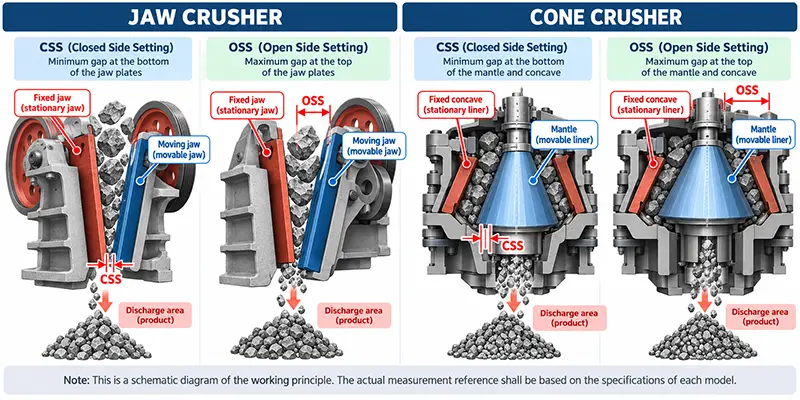
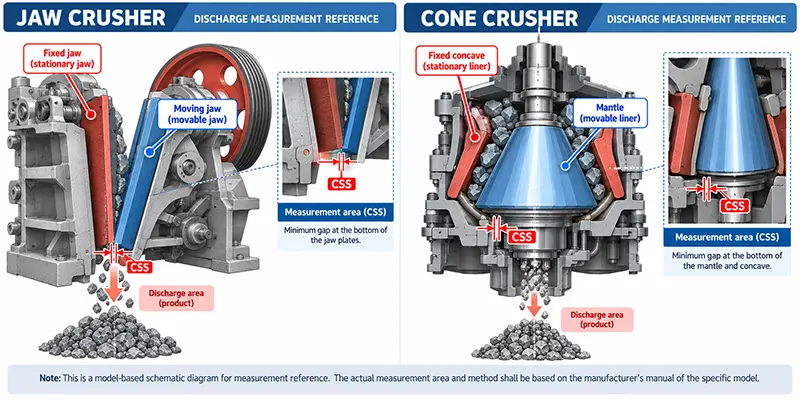
CSS describes the smallest opening at the manufacturer’s specified measurement location. In a jaw crusher, this relates to the discharge region between the jaw dies. In a cone crusher, it relates to the discharge region between the mantle and the concave or bowl liner.
The important point is that CSS is a defined machine setting. It is not simply any gap visible at the bottom of the chamber.
For example, a stationary machine may not be positioned at its minimum opening. A direct measurement at that position should not automatically be recorded as CSS without checking the manufacturer’s procedure.
2. CSS vs OSS: What Is the Difference?
OSS means open side setting. It describes the largest discharge opening at the specified reference location during the crushing cycle.
| Item | CSS | OSS |
|---|---|---|
| Full name | Closed side setting | Open side setting |
| Basic meaning | Minimum discharge opening | Maximum discharge opening |
| Machine condition | Crushing surfaces at their closest relevant position | Crushing surfaces at their widest relevant position |
| Practical purpose | Operating-setting reference for crushing performance | Reference for understanding opening movement and certain measurement procedures |
| Main caution | Do not confuse it with finished-product size | Do not record it as CSS without the required conversion or procedure |
The difference between the two openings is related to the motion of the crushing surfaces at the measurement point.
However, eccentricity, eccentric throw and discharge-point stroke should not be treated as interchangeable values. Use only the relationship and dimensions defined for the specific machine.
A formula or measurement instruction taken from another crusher model may produce an incorrect CSS value.
3. Is CSS Measured the Same Way on Every Crusher?
No. The general concept is similar, but the reference surfaces, machine position and verification method depend on the crusher design.
Jaw crusher measurement
Before checking a jaw crusher setting, confirm:
The exact model and installed jaw-die profile.
The reference points specified for the discharge measurement.
Whether the measured opening represents CSS or OSS.
Whether the manual requires a model-specific conversion.
The effect of uneven jaw wear on the measurement.
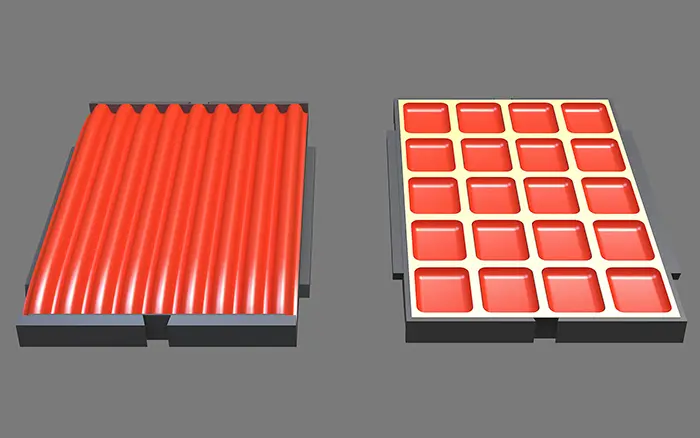
Tooth peaks, roots and worn surfaces can give different readings. Use the specified reference points rather than whichever surfaces are easiest to reach.
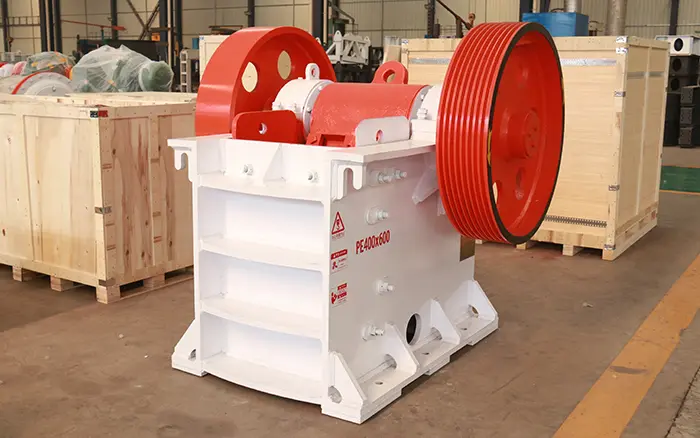
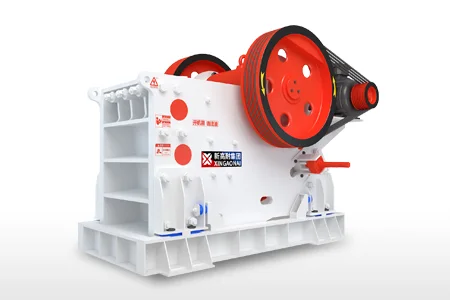
A machine such as the PEV Series Jaw Crusher must be evaluated using documentation for the actual model and installed configuration, not a generic setting value from another machine.
Adjustment hardware is a separate subject. For the broader adjustment topic, see our jaw crusher gap adjustment guide; model-specific instructions remain controlling.
Cone crusher measurement
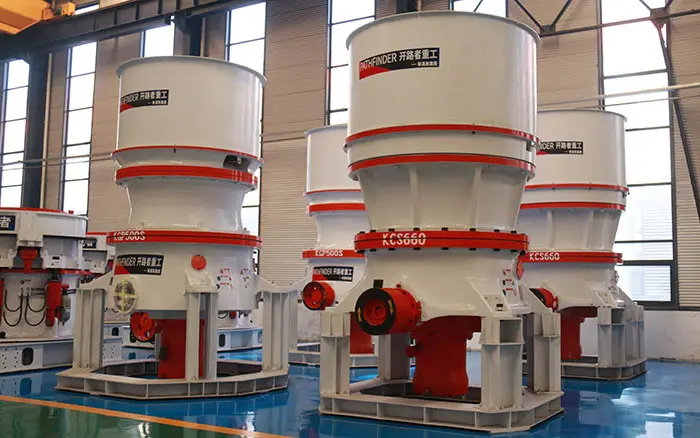
For a cone crusher, identify the specified discharge reference between the mantle and concave or bowl liner. The chamber profile, liner wear and calibration method all matter when interpreting the setting.
A control-system value should be interpreted according to the equipment’s calibration procedure. Do not assume that a displayed setting and an independently measured opening are automatically equivalent.
The changing opening follows the mantle’s eccentric movement. Our explanation of how a cone crusher works provides the mechanical background without replacing the machine’s measurement instructions.
4. Why CSS Is Not the Same as Product Size
A crusher operating at a 20 mm CSS should not automatically be described as producing only material below 20 mm.
The discharge opening is not a square-aperture test sieve. Particles have different shapes and orientations, and the opening changes during the crushing cycle. The resulting product is a size distribution rather than a single particle size.
Three terms should be kept separate:
CSS: A machine operating setting.
P80: The particle size at which 80% of the sampled material passes by mass.
Product specification: The required grading or size limits, verified using the applicable sampling and testing procedure.
There is no universal rule that CSS equals P80 or the maximum product size.
The crusher discharge must also be distinguished from the final screened product. A downstream screen and a return-material circuit can change which particles reach the finished-product stockpile.
If the final product becomes coarser, check whether the change originates in the crusher discharge, the screening stage or material routing before changing CSS.
5. How Does CSS Affect Crushing Performance?
Changing CSS can affect product grading, throughput, operating load and wear. The outcome also depends on feed conditions, chamber geometry and the machine’s permitted operating range.
Metso’s technical guidance likewise discusses CSS together with product gradation, capacity and power draw, rather than treating it as an isolated setting. See Metso’s crushing-chamber selection guidance.
| Setting change | Possible tendency under comparable conditions | What must be checked |
|---|---|---|
| Smaller CSS | Finer product; throughput may decrease | Operating load, fines generation and the permitted minimum setting |
| Larger CSS | Coarser product; throughput may increase | Downstream capacity and product grading |
| Setting changes as liners wear | Product distribution may drift | Actual opening, wear profile and calibration |
| Same CSS on a different model or chamber | Performance may differ | Feed, chamber geometry, motion and operating conditions |
These are tendencies, not guaranteed results or fixed percentage changes.
For equipment such as the XHP Series Multi-Cylinder Hydraulic Cone Crusher, the acceptable setting must be checked against the selected model, chamber and operating conditions. A setting suitable for one configuration may be unsuitable for another.
6. What Should You Check Before Changing CSS?
Do not reduce the setting simply because the final product contains more oversize material.
First, check the following.
Confirm the measurement
Verify the reference points, machine position, units and approved measuring method. Record whether the value was measured directly or obtained from the control system.
Inspect liner condition
Wear can change the opening and the chamber profile. Uneven wear may affect performance even when the nominal setting appears unchanged.
Review the feed
Check for changes in feed grading, maximum lump size, moisture, clay content and feed distribution. An altered feed can change the product without any intentional setting adjustment.
Check the screen and return circuit
Inspect for damaged panels, incorrect apertures, blinding and unintended material bypass. Record changes in return load where relevant.
Check equipment limits and operating load
Confirm that the proposed setting is permitted. Review available load indicators and alarms rather than relying only on the appearance of the product.
If another fault is causing the problem, tightening the setting may increase operating stress without correcting the final grading.
7. Keep a CSS Verification Record
A useful record connects the machine setting with the conditions under which the product was sampled.
| Information to record | Required detail |
|---|---|
| Equipment | Model, serial number and chamber or jaw-die profile |
| Liner condition | Installation date, service history and observed wear |
| Setting | Recorded CSS, measurement method, reference points and units |
| Feed | Material, grading, maximum size, moisture and clay condition |
| Operating conditions | Throughput and available load indicators |
| Sampling | Location, date, operating condition and approved sampling method |
| Product results | Sieve analysis, oversize fraction and P80 where relevant |
| Circuit condition | Screen configuration, return material and any bypass |
| Review | Person responsible, observations and approved action |
Compare results only after noting relevant changes in operating conditions. A before-and-after comparison is difficult to interpret if the feed, chamber, screen or sampling location also changed.
Conclusion
Closed side setting is an important crushing parameter, but it is only useful when the measurement convention and operating conditions are understood.
Distinguish CSS from OSS, product maximum size and P80. Check measurement accuracy, liner condition, feed and screening performance before changing the setting.
When contacting XINGAONAI about equipment selection or a discharge-setting question, provide the model, chamber information, current measurement method, material characteristics, required capacity and product grading. Include available photographs, drawings and sieve results so the discussion is based on the actual application.