

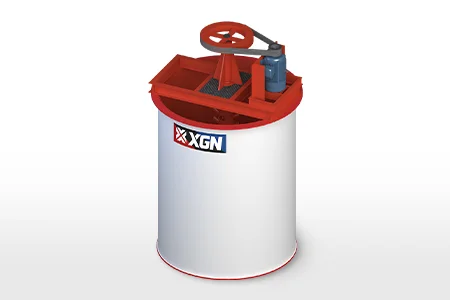
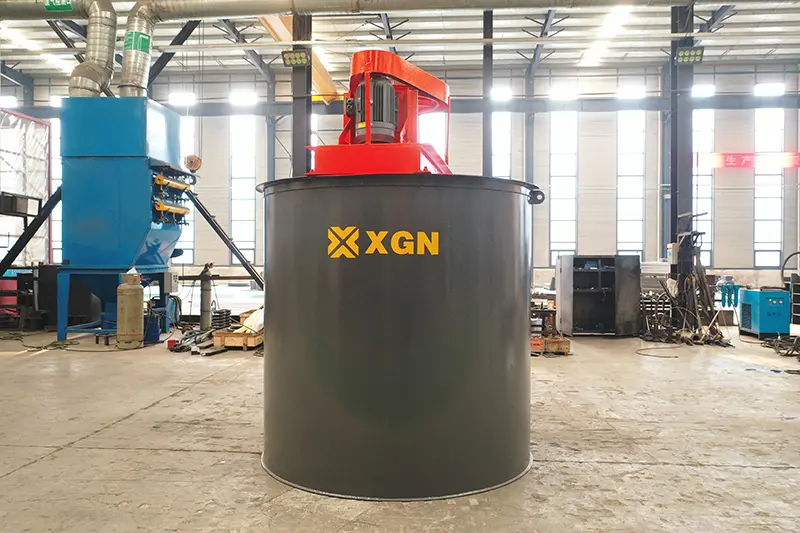
Working Principle of an Agitation Tank
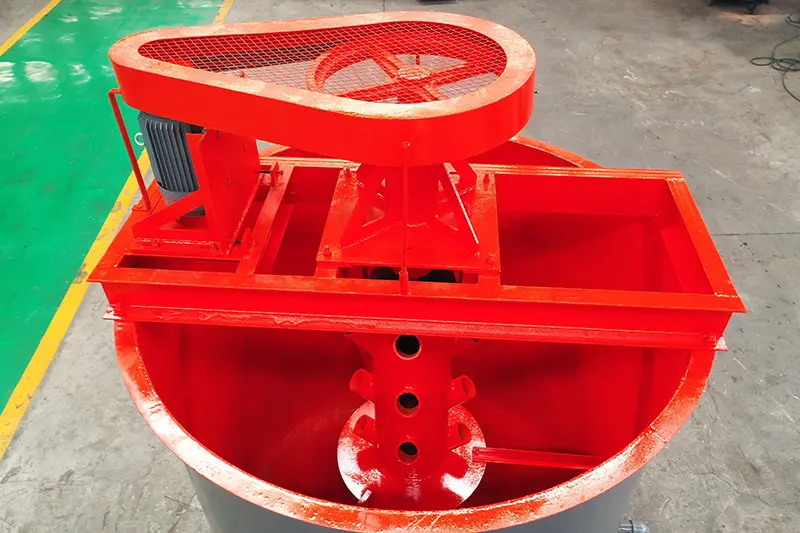
Power Transmission: The motor drives the reducer to reduce speed, which then drives the stirring shaft to rotate. The rotation speed can be adjusted according to material properties and mixing requirements, ensuring optimal stirring effect.
Stirring Action: The stirring shaft is equipped with impellers (common types include propeller, anchor, and turbine impellers). As the impellers rotate, they generate strong shearing force and turbulent flow, pushing materials to move in the tank in a circular or radial direction.
Uniform Mixing: Reagents are added to the tank while stirring. The turbulent flow generated by the impellers ensures that reagents fully combine with materials, avoiding local concentration or uneven distribution. For ore slurry in mining applications, this process helps reagents adhere to mineral particles, improving subsequent beneficiation efficiency.
Auxiliary Functions: Some agitation tanks are equipped with heating or cooling jackets to control the temperature of the mixing system, adapting to processes that require specific temperature conditions. Additionally, the tank body is designed with a reasonable structure to reduce material residue and facilitate cleaning.
Key Features of an Agitation Tank
High Mixing Efficiency: Optimized impeller structure and rotation speed design enable rapid and uniform mixing of materials, shortening the mixing cycle and improving production efficiency. It can handle materials with different viscosities, from low-viscosity solutions to high-viscosity slurries.
Stable Operation: The tank body is made of high-quality steel (carbon steel, stainless steel) or corrosion-resistant materials, with strong structural stability. The motor and reducer adopt reliable components, ensuring long-term continuous operation with low failure rate.
Flexible Adjustment: The stirring speed and impeller type can be customized according to actual needs. Some models are equipped with frequency conversion speed control, allowing real-time adjustment to adapt to different process stages.
Easy Maintenance: The tank body has a simple structure, with detachable impellers and stirring shafts for convenient inspection and replacement. The inner wall is smooth, reducing material scaling and simplifying daily cleaning work.
Wide Adaptability: It can be used in various industries and processes, such as ore beneficiation, chemical reaction, food mixing, and pharmaceutical preparation. Different materials and structures can be selected to meet special requirements (e.g., corrosion resistance, high temperature resistance).
Industrial Applications of Agitation Tanks
Mining Industry: It is mainly used in beneficiation processes such as flotation and leaching. For example, in non-ferrous metal beneficiation, it stirs ore slurry with flotation reagents to promote the separation of useful minerals from gangue. It is also used in coal preparation and mineral processing of precious metals.
Chemical Industry: Used for mixing chemical raw materials, promoting chemical reactions, and preparing solutions. It is suitable for processes such as pesticide production, dye preparation, and polymer synthesis, ensuring the stability of product quality.
Pharmaceutical Industry: Used in the mixing of pharmaceutical raw materials, preparation of medicinal solutions, and fermentation processes. It meets GMP standards, with clean and corrosion-resistant tank bodies to avoid contamination of medicinal products.
Food Industry: Applied to the mixing of food raw materials, such as beverage preparation, dairy product blending, and seasoning mixing. The stainless steel tank body ensures food safety and hygiene, adapting to the strict requirements of the food industry.
Environmental Protection Industry: Used in wastewater treatment processes, such as mixing wastewater with flocculants to promote the precipitation of impurities. It helps improve wastewater treatment efficiency and meets environmental emission standards.
How to Choose an Agitation Tank
Material Properties: Consider the viscosity, density, and corrosiveness of materials. For corrosive materials, choose tanks made of stainless steel or lined with corrosion-resistant materials; for high-viscosity materials, select impellers with strong stirring force.
Production Capacity: Determine the volume of the agitation tank according to the required processing capacity, ensuring it matches the overall production line efficiency.
Process Requirements: If the process requires temperature control, select a model with a heating or cooling jacket; for processes requiring precise mixing, choose a frequency conversion speed control model.
Working Environment: For harsh environments (e.g., high temperature, humidity), select an agitation tank with dust-proof, waterproof, and corrosion-resistant motor and electrical components.