

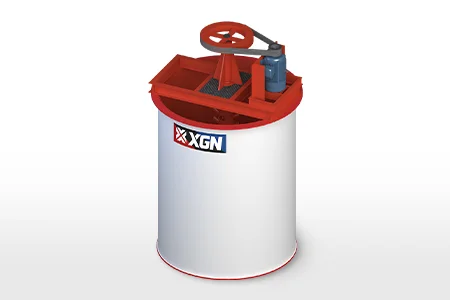
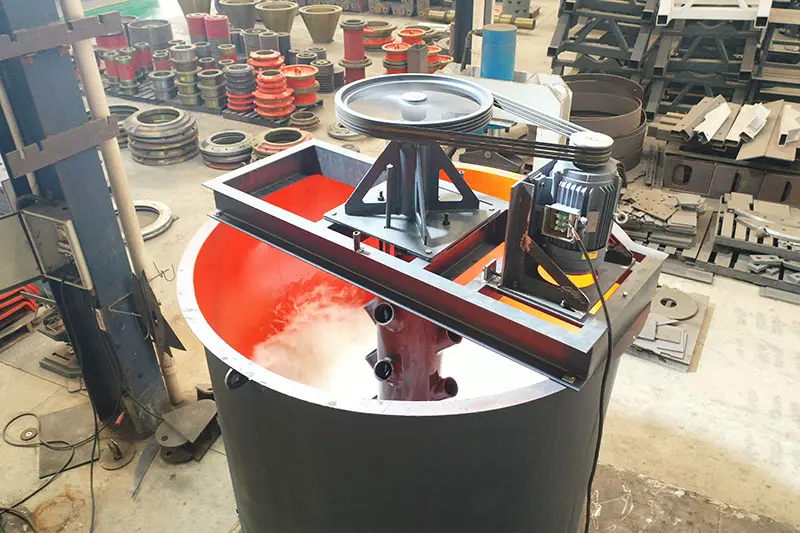
Key Components of an Agitation Tank: Foundation for Its Operation
Tank Body: A cylindrical or rectangular vessel (usually made of stainless steel, carbon steel, or plastic) that holds the materials to be agitated. It may include baffles (vertical plates inside the tank) to prevent swirling and ensure uniform mixing.
Agitator Impeller: The heart of the agitation tank. It’s a rotating component with blades of different shapes (e.g., paddle, turbine, anchor) that generates fluid flow and shear force to mix materials.
Drive System: Consists of a motor, reducer, and coupling. It provides the power to rotate the impeller at a controlled speed (typically 10-500 rpm, depending on the application).
Shaft: Connects the impeller to the drive system, transmitting torque to the impeller for rotation.
Shaft Seal: Prevents leakage of materials from the tank and protects the shaft from corrosion. Common types include mechanical seals and packing seals.
Inlet/Outlet Ports: For feeding materials into the tank and discharging the mixed product. Some tanks also have ports for adding additives, sampling, or installing sensors.
How Does an Agitation Tank Work? Step-by-Step Mechanism
Material Feeding: The materials to be mixed (e.g., liquids, powders, slurries) are first added to the agitation tank through the inlet port. The filling volume is typically 60-80% of the tank’s total capacity to leave space for agitation and prevent overflow.
- Impeller Rotation (Core Stage): When the drive system is activated, the motor’s power is transmitted to the impeller via the reducer and shaft, causing the impeller to rotate at a preset speed. As the impeller blades spin, they push the surrounding fluid, creating two key types of flow:
Axial Flow: Fluid moves parallel to the shaft (upward or downward), ensuring vertical mixing of materials in the tank.
Radial Flow: Fluid moves perpendicular to the shaft, spreading outward from the impeller to the tank walls.
Uniform Mixing via Fluid Motion: The combination of axial and radial flow creates a turbulent or laminar fluid environment inside the tank (depending on the impeller speed and material viscosity). Baffles installed in the tank break up swirling flow (a common issue in unbaffled tanks) and redirect the fluid, enhancing shear force and ensuring every part of the material is evenly mixed. For solid-liquid mixing (e.g., suspending solid particles in a liquid), the impeller’s flow lifts and disperses the solids, preventing them from settling at the tank bottom.
Process Adjustment & Monitoring: During agitation, operators can adjust the impeller speed, mixing time, or add additives through dedicated ports to meet specific process requirements. Sensors (e.g., temperature, pH, viscosity sensors) may be used to monitor the mixed material’s properties in real time.
Discharging the Mixed Product: Once the mixing process is complete, the homogenized material is discharged from the tank through the outlet port for subsequent production steps (e.g., filtration, reaction, packaging).
Factors Influencing the Working Efficiency of an Agitation Tank
Impeller Type & Size: Different impeller shapes are designed for specific tasks. For example, turbine impellers are ideal for gas-liquid mixing, while anchor impellers are suitable for high-viscosity materials. Larger impellers generate more fluid flow, improving mixing efficiency.
Impeller Speed: Higher speeds create stronger turbulence and shear force, accelerating mixing. However, excessive speed may increase energy consumption and cause material splashing.
Material Properties: Viscosity (thickness) of the material greatly affects mixing. High-viscosity materials require more powerful impellers and higher speeds, while low-viscosity liquids mix more easily. The density and particle size of solid materials also influence suspension efficiency.
Tank Design: The presence of baffles, tank shape (cylindrical tanks are more efficient than rectangular ones), and filling volume all impact flow patterns and mixing uniformity.
Agitation Time: Longer mixing times can improve uniformity, but excessive time increases energy costs. The optimal time is determined by the material type and process requirements.
Common Types of Agitation Tanks & Their Working Characteristics
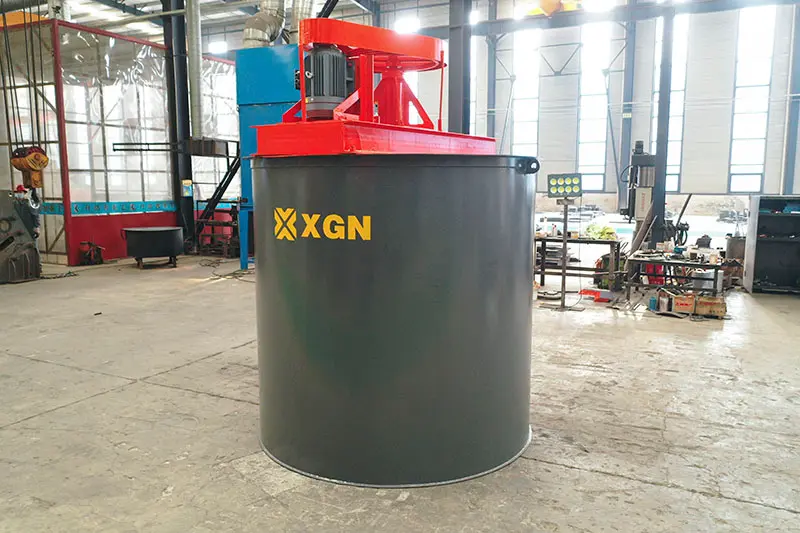
Mechanical Agitation Tank: The most common type, using a motor-driven impeller for mixing. It’s versatile and suitable for most industries, from chemical to food processing.
Pneumatic Agitation Tank: Uses compressed air instead of a mechanical impeller to agitate materials. Compressed air is blown into the tank bottom, creating bubbles that rise and mix the fluid. It’s ideal for explosive or corrosive environments where electric motors are unsafe.
Magnetic Agitation Tank: Uses magnetic force to drive the impeller, eliminating the need for a shaft seal. This prevents material leakage, making it suitable for high-purity applications (e.g., pharmaceuticals, semiconductor manufacturing).
High-Shear Agitation Tank: Equipped with a special high-speed impeller that generates strong shear force, ideal for emulsification (e.g., mixing oil and water) or dispersing fine particles.
Applications of Agitation Tanks: Where Their Working Principle Adds Value
Mining Industry: Mixing ore slurries, flotation reagents, and leaching solutions to enhance mineral separation efficiency.
Chemical Industry: Blending raw materials for chemical reactions, dissolving solids in solvents, and homogenizing coatings or adhesives.
Food & Beverage Industry: Mixing ingredients for sauces, beverages, dairy products, and dough; dissolving sugar or salt in liquids.
Pharmaceutical Industry: Preparing drug solutions, emulsions, and suspensions; ensuring uniform distribution of active ingredients.
Wastewater Treatment: Mixing sewage with flocculants to promote solid-liquid separation and purify water.