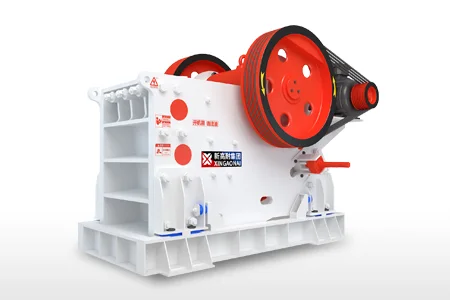
Rocks that repeatedly bounce near the top of a jaw crusher can interrupt feeding and reduce effective throughput. Poor grip is one possible cause, but oversized feed, bridging, worn jaw plates and restricted discharge can produce similar symptoms.
The jaw crusher nip angle helps explain how material is gripped between the fixed and moving jaws. However, the angle alone cannot describe the entire crushing process. Jaw profiles, particle shape, surface conditions and operating settings also affect whether a rock is held and broken.
This guide explains what nip angle means, how it differs from closed side setting, and what to inspect before requesting replacement jaw plates or changes to the crushing chamber.
What Is Jaw Crusher Nip Angle?
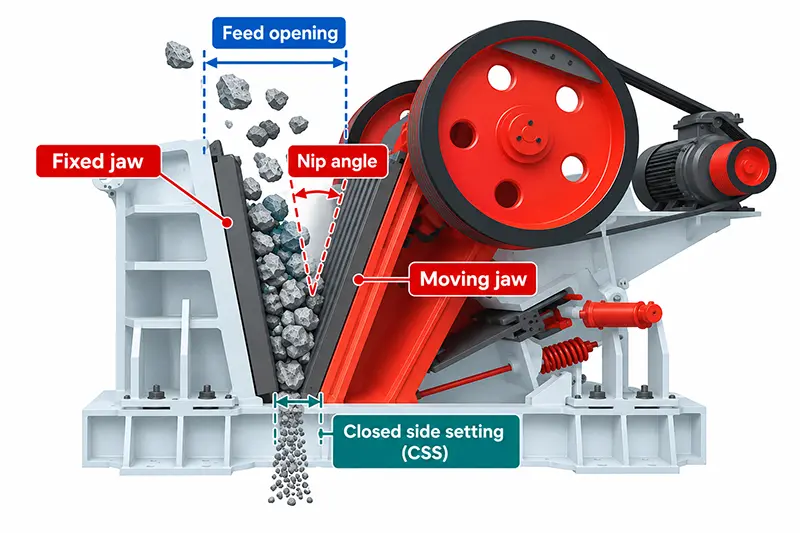
Jaw crusher nip angle is the included angle between the opposing fixed and moving jaw surfaces.
As the moving jaw approaches the fixed jaw, the surfaces apply compressive forces to the material. The rock must remain sufficiently gripped for those forces to break it rather than push it upward or allow it to slip.
Terex’s jaw crusher resources describe nip angle as the angle between the jaw dies that indicates the machine’s ability to draw material into the chamber and crush it.
In a simplified diagram, two straight jaw surfaces form an easily identified angle. Actual chambers are more complicated: jaw plates may be curved, corrugated or unevenly worn. Their local contact geometry can vary along the chamber.
For this reason, an angle estimated from an ordinary photograph should not be treated as the crusher’s verified nip angle.
The nip angle is also different from the toggle plate angle, which describes part of the crusher’s mechanical linkage.
What Is the Correct Nip Angle for a Jaw Crusher?
There is no single nip angle that is correct for every jaw crusher.
In a simplified gripping model, an excessively wide angle can make it more difficult to hold a particle between the jaws. Actual performance also depends on friction, particle shape, jaw movement and the installed crushing surfaces.
A smaller angle should therefore not automatically be described as better. Chamber geometry must work with the machine’s feed opening, discharge setting, jaw travel and mechanical design.
The appropriate configuration depends on:
Crusher model and chamber design.
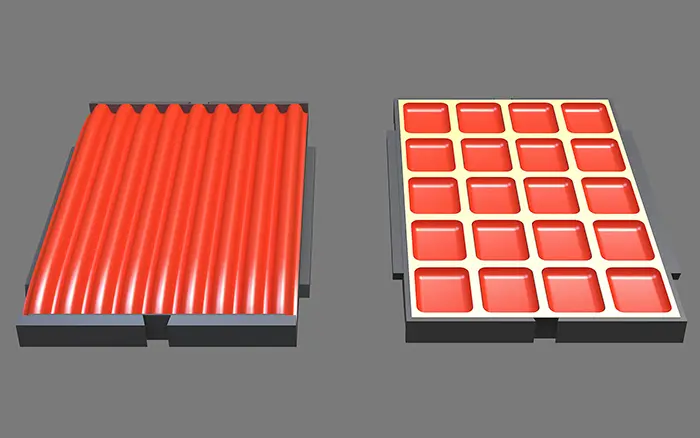
Fixed and moving jaw profiles.
Feed size distribution and particle shape.
Material strength and surface conditions.
Jaw plate wear.
Manufacturer-approved operating settings.
Published angles for a particular crusher series should not be applied to another machine without confirmation.
For an existing crusher, the useful question is not simply, “What angle should I use?” It is:
Does the installed chamber configuration suit this machine, material and operating condition?
Nip Angle vs CSS vs Feed Opening
Nip angle, feed opening and closed side setting describe different features of the crushing chamber.
| Parameter | What it describes | Practical relevance |
|---|---|---|
| Nip angle | The included angle between opposing jaw surfaces | Helps explain material gripping conditions |
| Feed opening | The inlet dimensions of the chamber | Helps determine whether the incoming material is suitable |
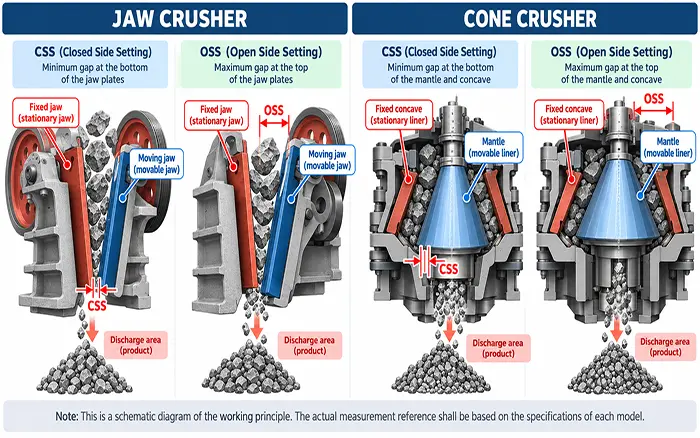
| Closed side setting, or CSS | The discharge opening at the manufacturer’s specified closed position and measurement reference | Influences discharge conditions and product size distribution |
Changing CSS alters operating conditions, but the relationship between CSS and chamber geometry is model-specific. There is no universal adjustment rule that applies to every jaw crusher.
CSS also does not represent the maximum finished particle size. Feed characteristics, rock breakage and operating conditions affect the resulting size distribution.
For a separate explanation of discharge settings, see closed side setting in a crusher.
Why Does Material Slip Between the Jaws?
Material can slip when the contact conditions do not provide enough grip for effective crushing. Several factors may contribute.
Worn or Unsuitable Jaw Profiles
Jaw teeth determine how the crushing surfaces contact the rock.
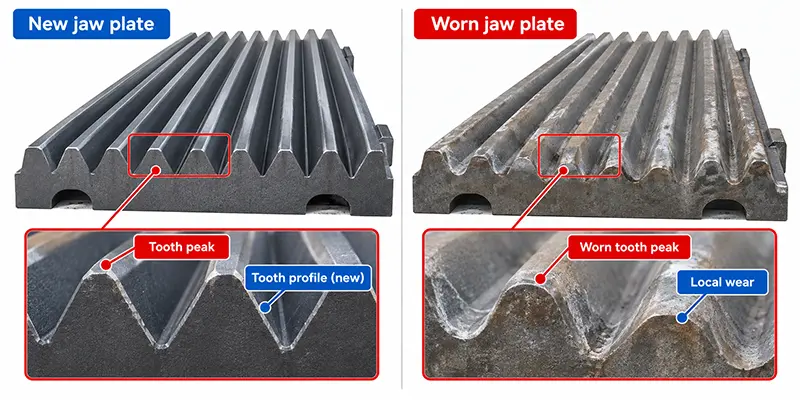
As teeth wear, their shape and contact conditions change. Uneven wear can also alter the chamber profile. A crusher that previously accepted the feed consistently may begin to show irregular material movement.
However, wear is not the only concern. New plates with an unsuitable profile or an incorrect fixed-and-moving jaw combination can also affect performance.
Metso’s chamber selection guidance explains how jaw profiles influence gripping and fines handling. Its examples concern Metso equipment, but they illustrate why profile selection must match the application.
For additional background, see jaw crusher liner profiles and wear.
Difficult Feed Shapes
Feed opening dimensions do not fully describe how a particle will behave.
Flat slabs, elongated pieces and rounded rocks can contact the jaws differently. Some pieces may rotate, bridge or repeatedly change position before breaking.
When investigating poor grip, record both the feed size distribution and the shape of the troublesome particles.
Moisture, Clay and Fines
Sticky fines can accumulate and restrict material movement. Moisture or surface coatings may also change the contact conditions between the rock and jaw plates.
These conditions require a review of the feed and material flow. Changing the discharge setting alone may not solve the problem.
Uneven Feeding or Restricted Discharge
Uneven feeding can produce inconsistent chamber loading and localized wear.
A blockage or accumulation below the crusher can also prevent material from leaving normally. This may resemble a chamber acceptance problem even when the incoming rocks can be gripped.
Check the complete material path before attributing the symptom to nip angle.
Slippage, Bridging and Packing: What Is the Difference?
These conditions may occur together, but they should not be treated as the same problem.
| Observation | Possible explanation | What to check first |
|---|---|---|
| Individual rocks repeatedly bounce or move upward | Poor grip or difficult particle geometry | Feed shape, jaw profile and wear |
| Large pieces remain across the chamber entrance | Bridging or oversized feed | Top size, elongated particles and feed distribution |
| Sticky material accumulates inside the chamber | Packing or restricted material flow | Clay, moisture and fines content |
| Material builds up below the crusher | Restricted discharge or downstream congestion | Chutes, conveyors and downstream equipment |
| Feeding changes after jaw plate replacement | Different profiles, incorrect matching or installation issues | Part numbers, drawings and installation records |
A short video can help identify where material movement becomes irregular. It cannot establish the nip angle or prove which factor caused the problem.
How to Check a Suspected Nip Angle Problem
1. Establish When the Symptom Started
Record whether the problem:
Appeared after jaw plate replacement.
Developed gradually during operation.
Occurs only with certain materials.
Coincides with more oversize or slab-shaped feed.
Appears during uneven feeding or downstream congestion.
This history helps distinguish changes in the chamber from changes in the feed or plant.
2. Review the Feed and Material Flow
Check the actual feed against the manufacturer’s permitted conditions.
Include particle size distribution, shape, moisture, clay and fines. Inspect the feeder discharge pattern and confirm that crushed material can leave the crusher freely.
Correct an identified flow restriction before assessing the result of a chamber change.
3. Identify the Installed Jaw Plates
Record the crusher model, serial number and fixed and moving jaw plate part numbers.
Confirm that the installed plates form an approved combination for the machine. Similar appearance or matching overall dimensions alone does not establish the intended chamber geometry.
If component identification is unclear, consult the jaw crusher parts guide before preparing the enquiry.
4. Verify CSS and Jaw Condition
Measure CSS using the manufacturer’s specified procedure and reference points.
Do not assume that the visible gap on a stationary machine is automatically CSS. Jaw position and measurement conventions matter.
Inspect plate wear, seating and fastening according to the equipment manual. Physical inspection requires equipment isolation under the site’s approved procedure.
5. Request a Model-Specific Review
Provide the supplier with the machine details, jaw plate information, feed characteristics and operating records.
Nip angle is not necessarily an independently adjustable site setting. An approved chamber change may involve different jaw profiles rather than a routine CSS adjustment.
Do not improvise wedges, alter toggle arrangements or modify structural components to change an estimated angle.
6. Check the Result Under Comparable Conditions
After an approved change, compare operation using reasonably similar feed and settings.
Useful records include:
Measured throughput.
Feeding interruption frequency.
Motor current or power under comparable loading.
Feed and product size distributions.
Jaw wear patterns over time.
Change one relevant variable at a time where practicable. Otherwise, it becomes difficult to determine which change affected performance.
Smoother operation is useful evidence, but a throughput improvement should be supported by measurement.
Can Jaw Crusher Nip Angle Be Measured on Site?
A meaningful measurement requires a defined reference.
Before attempting to measure the angle, confirm:
Which jaw surfaces or profile references should be used.
Where along the chamber the angle is defined.
The required position of the moving jaw.
Whether the reference concerns new or worn plates.
The manufacturer’s approved measurement method.
Placing a straightedge across corrugated teeth or drawing lines on a photograph may not reproduce the manufacturer’s chamber definition.
If no approved site measurement method is available, submit the jaw plate drawings, wear photographs and machine information for review. Do not convert a visual estimate into a precise specification.
Information to Prepare for a Replacement-Parts Enquiry
A request stating only “the nip angle is wrong” is insufficient to confirm suitable replacement parts.
Prepare the following information:
| Information | Why it is useful |
|---|---|
| Crusher model and serial number | Identifies the equipment configuration |
| Jaw plate part numbers or drawings | Helps confirm the installed profiles and compatibility |
| Clear wear photographs | Shows tooth condition and localized wear |
| Feed material and size distribution | Describes the application |
| Particle shape, moisture and clay content | Helps explain difficult material movement |
| Current CSS and measurement method | Establishes the operating setting |
| Description of when the symptom occurs | Helps narrow the possible causes |
| Available operating records | Supports comparison and assessment |
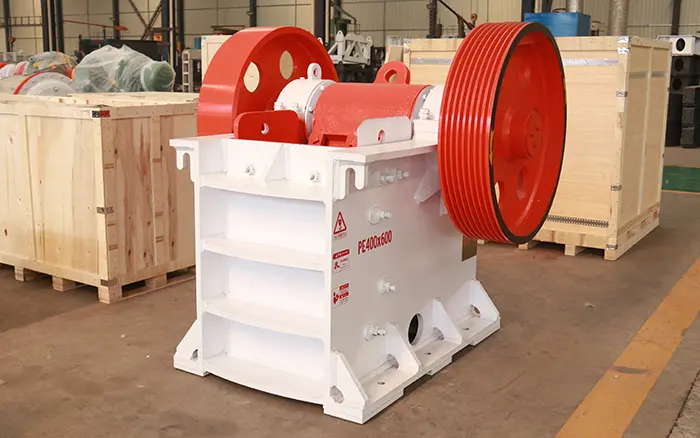
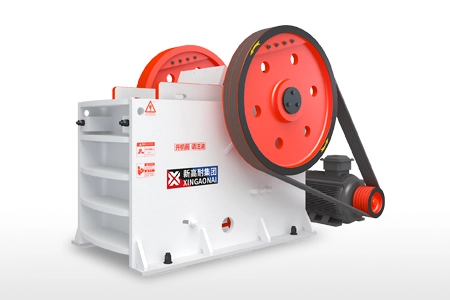
For a PEV Series jaw crusher, include the machine identification and installed jaw plate details when requesting replacement parts from XINGAONAI.
If the original part number is unavailable, provide dimensions and drawings for compatibility review before ordering.