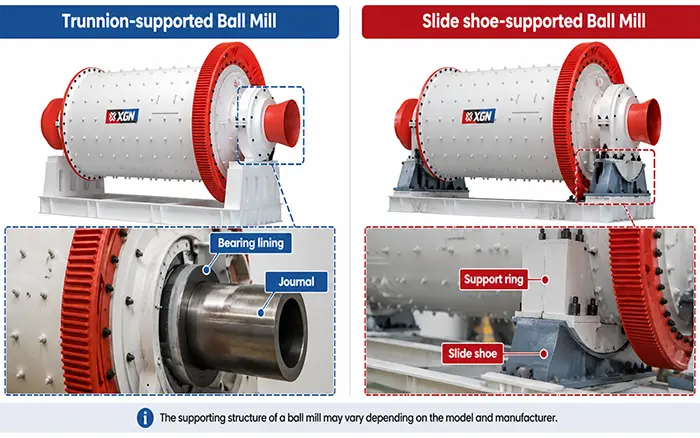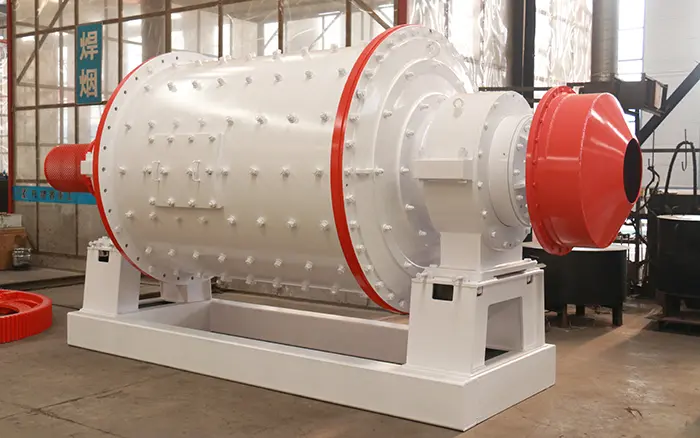
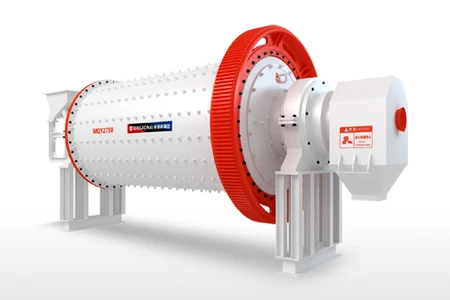
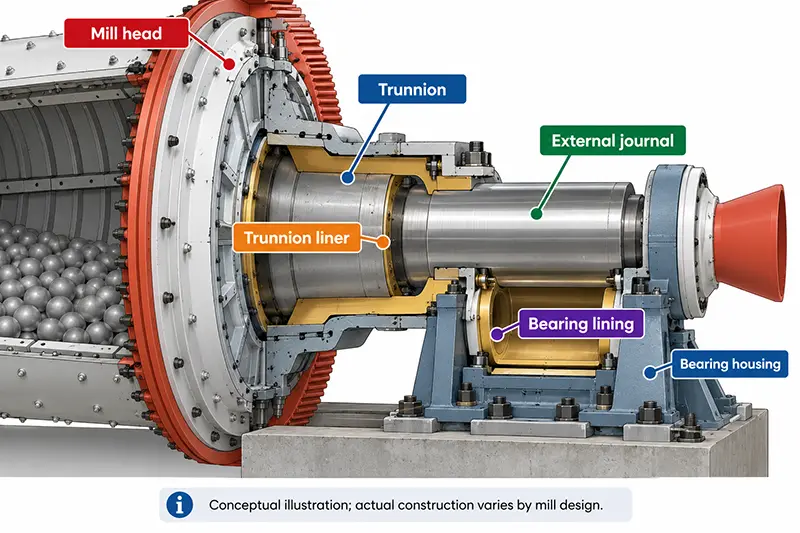
A ball mill trunnion is the hollow journal at the end of a trunnion-supported mill. Its external journal works with the main bearing to support the rotating assembly, while its central passage accommodates feeding or discharge, depending on the mill design.
The trunnion is not the same component as the trunnion bearing or trunnion liner. This distinction matters when investigating damage: a worn liner, leaking seal or overheated bearing does not automatically mean that the trunnion itself needs replacement.
This guide focuses on identifying the trunnion, recognizing conditions that require inspection, and preparing the information needed to assess a replacement component.
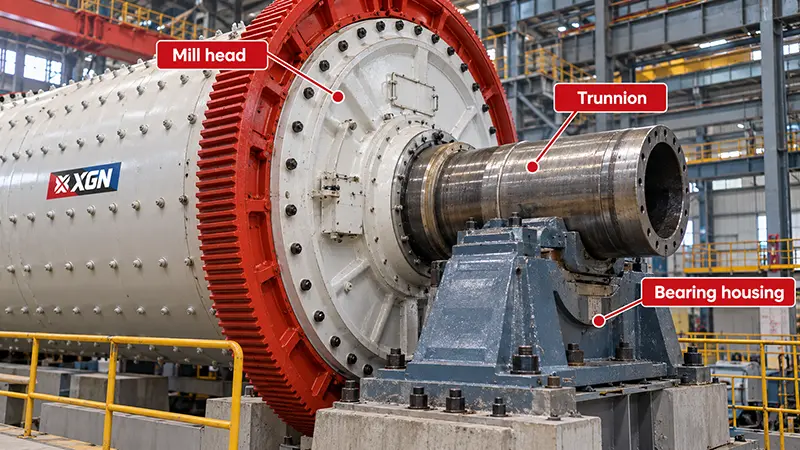
What Does a Ball Mill Trunnion Do?
In a trunnion-supported ball mill, the trunnion has two closely related functions.
First, its external journal transfers support loads from the rotating mill assembly to the main bearing. The condition and geometry of this journal are therefore important to the bearing interface.
Second, its hollow center provides a passage for the material-handling arrangement at that end of the mill. A feed-end passage accommodates incoming material, while the discharge-end arrangement allows ground material to leave the mill.
The trunnion also interfaces with surrounding components, which may include seals, internal liners and connections to the mill head.
Not every ball mill uses this support arrangement. Mills supported through slide shoes beneath shell support rings have a different load path and should not be assumed to use the same end-journal components.
For the position of the trunnion within the complete machine, see our overview of ball mill components and their functions.
Trunnion, Bearing and Liner: Identify the Correct Component
Several parts occupy the same area, but they perform different jobs.
| Component | Location and function | Why the distinction matters |
|---|---|---|
| Trunnion | Rotating hollow journal at the mill end | Damage to its load-bearing or mating surfaces requires assessment of the structural component |
| Trunnion bearing | Supports the external journal | Bearing damage may occur without requiring replacement of the entire trunnion |
| Trunnion liner | Where fitted, protects the internal material passage | Internal liner wear is not automatically damage to the trunnion body |
| Bearing lining or pads | Load-carrying surfaces within a plain bearing arrangement | These are different from the liner inside the material passage |
| Mill head | End structure connecting the shell to the end assembly | Its connection with the trunnion must be identified from the actual design |
These are not simply different names for the same spare part. FLSmidth’s technical drawing, for example, labels the trunnion, mill head, trunnion liner and bearing liner separately. FLSmidth trunnion replacement datasheet
The journal is part of the trunnion; it is not the bearing itself. Similarly, the internal trunnion liner should not be confused with the lining inside a main bearing.
For an explanation of the supporting bearing arrangements, refer to our separate guide to ball mill bearing types.
Feed and Discharge Trunnions Are Not Automatically Interchangeable
Feed and discharge trunnions serve different ends of the mill. Their internal passages and connections must accommodate the corresponding feeding or discharge arrangement.
Depending on the design, differences may involve:
Internal bore and liner geometry.
Overall length and journal dimensions.
Connections to the mill head.
Interfaces with feed or discharge equipment.
Seal locations and associated components.
Two trunnions can look similar in photographs without being interchangeable.
When identifying a replacement, confirm both the installation end and the original part number or drawing. “For a ball mill of the same diameter” is not sufficient identification.
The discharge arrangement also matters. A component intended for one mill configuration should not be assumed suitable for a different overflow or grate-discharge design.
Signs That Require Trunnion Inspection
Operating symptoms help identify where to investigate, but they do not establish the condition of the trunnion on their own.
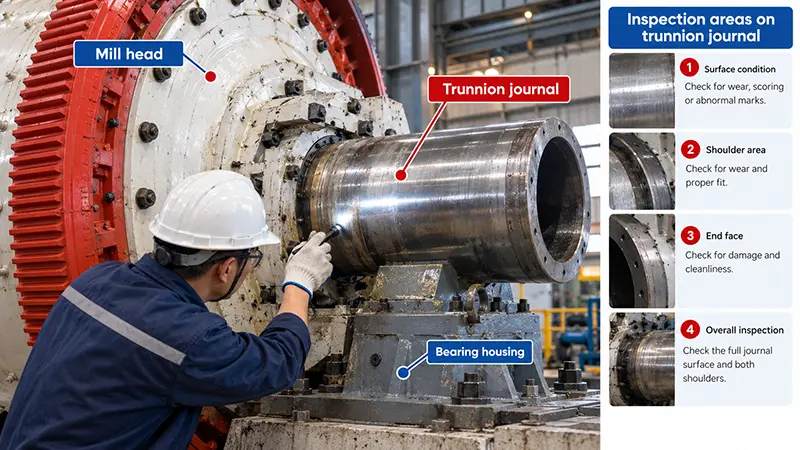
Journal Scoring or Uneven Wear
Visible grooves, scoring or uneven contact marks on the external journal require examination of both the journal and its supporting bearing.
Record where the damage occurs and whether it extends around the circumference or is concentrated in one area. Qualified personnel should compare measurements with the approved drawing and inspection criteria.
Do not assume that fitting a new bearing will compensate for an unsuitable journal surface.
Abnormal Bearing Temperature or Vibration
A change in bearing temperature or vibration can justify inspection of the journal interface. However, possible causes also include lubrication problems, bearing damage, cooling issues, alignment or changes in operating load.
Temperature alone cannot determine whether the trunnion needs replacement.
The investigation should establish whether the problem lies in the bearing system, the journal surface, the support arrangement or more than one component.
Leakage Around the End Assembly
Identify what is leaking and its exact source.
Slurry leakage near the material passage, oil leakage from a bearing housing and leakage at a seal interface are different observations. None should be described simply as “trunnion failure” without inspection.
Check the associated liner, seals and mating surfaces before defining the required spare part.
Loose Internal Liner or Damaged Connections
Movement of a trunnion liner or damage to its fasteners requires examination of the liner fit and surrounding surfaces.
Replacing fasteners alone may not address a worn or damaged interface. Metso’s grinding mill technical literature specifically discusses liner looseness and bolt damage associated with wear between the trunnion and its liner. Metso grinding mill technical brochure
Suspected Cracks
A suspected crack in the trunnion or its connection area is a structural concern, not a routine wear observation.
Follow the site’s shutdown and isolation procedures and obtain qualified engineering assessment. Do not authorize continued operation or a repair solely from a photograph or a general online guide.
What Should Be Checked Before Deciding on Replacement?
The aim of inspection is to establish which component is damaged, how extensive the damage is, and whether the assembly can meet its approved requirements.
Before physical inspection, qualified personnel must isolate and secure the equipment under the site’s procedures. Access, lifting and structural support require an approved work plan.
Journal Geometry and Surface Condition
An inspection plan may include journal diameter, roundness, taper, surface condition and runout relative to specified datums.
Measurements should cover the locations required by the drawing or engineering assessment. A single diameter reading is not enough to describe the condition of the entire journal.
Internal Bore and Liner Interface
Check the surfaces locating or supporting the internal liner, where fitted.
The inspection should distinguish damage to the replaceable liner from damage to the trunnion bore or its mating features.
Connection Faces and Fastener Locations
Where the design includes a separate trunnion-to-head connection, examine the relevant flange, connection faces, locating features and fastener holes.
Do not assume that all mills use the same connection arrangement.
Crack Assessment
The inspection method and acceptance criteria must be appropriate for the material, geometry and suspected defect.
A qualified inspection procedure should define the examination area, suitable testing methods and reporting requirements. The absence of an obvious surface crack does not, by itself, confirm structural acceptability.
Associated Components
Inspect the relevant bearing, seals and liner before finalizing the replacement scope.
A damaged mating component or unresolved lubrication problem can compromise a new part. Ordering the trunnion without checking its interfaces may leave the original cause of damage unresolved.
There is no universal allowable wear depth, journal tolerance or crack limit for every ball mill trunnion. Use the applicable drawings and approved engineering criteria.
Does Damage Always Mean the Trunnion Must Be Replaced?
No. The first decision is whether the damage affects the trunnion body or a separate component.
| Inspection finding | Appropriate next step |
|---|---|
| Damage confined to a replaceable internal liner | Assess the liner and confirm the condition of its trunnion interface |
| Damaged bearing lining with no established journal damage | Assess the bearing system and verify journal condition |
| Leakage without confirmed structural damage | Identify the leaking interface and inspect seals, liners and mating surfaces |
| Journal wear or damaged mating geometry | Obtain engineering assessment against the original design requirements |
| Confirmed structural cracking or deformation | Obtain a structural assessment and a documented disposition before return to service |
A repair-versus-replacement decision must consider the damage mechanism, remaining geometry, material, inspection results and consequences of failure.
Crack repair should not be presented as a universal permanent solution. FLSmidth’s replacement literature warns that repaired trunnions may develop further cracks or deformation affecting the bearing. That warning supports careful assessment; it does not replace a case-specific engineering decision. FLSmidth technical guidance
XINGAONAI supplies equipment and replacement parts, not trunnion refurbishment services. Any enquiry should first establish the required component and confirm whether it falls within the available supply scope.
Information Needed to Identify a Replacement Trunnion
A useful enquiry combines equipment identification, drawings and condition records.
1. Mill Identification
Provide:
Manufacturer and model.
Serial number or equipment identification.
Nameplate photograph.
Feed-end or discharge-end location.
Existing part number, where available.
Include details of previous modifications. The current assembly may differ from the original equipment configuration.
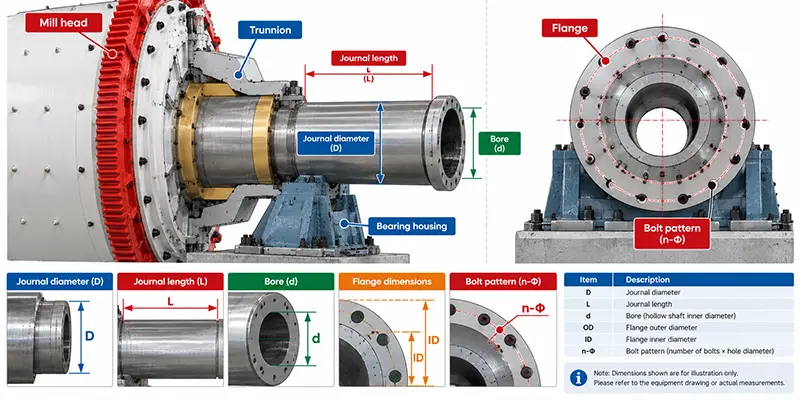
2. Drawings and Critical Interfaces
Provide the original component and assembly drawings where available.
Relevant features may include:
Journal diameter and bearing contact length.
Internal bore and overall length.
Connection flange and locating features.
Fastener-hole pattern.
Liner interface.
Seal-running surfaces.
Specified datums, tolerances and surface finish.
A simplified sketch can assist an initial discussion, but a complete manufacturing specification requires more than a few overall dimensions.
3. Material and Inspection Requirements
Include the material grade, heat-treatment requirements and inspection specifications stated on the approved documentation.
If those records are unavailable, identify the missing information clearly. Do not select a material simply because another supplier lists it for a visually similar part.
4. Damage and Operating Records
Useful supporting information includes:
Photographs showing the assembly and affected area.
Dimensional inspection reports.
Applicable crack-inspection reports.
Bearing or lubrication incidents associated with the damage.
Previous repairs or modifications.
Planned shutdown timing and project location.
Describe the requested scope clearly: trunnion only, associated liner, seals, bearing components or another defined assembly.
Before Installing a Replacement
A replacement part should not be treated as proof that the original problem has been resolved.
Before installation and return to service, the responsible team should confirm:
Component identification and inspection documentation.
Compatibility with the approved assembly.
Condition of the bearing and other mating components.
Relevant alignment and foundation checks.
Lubrication and sealing readiness.
Approved installation, inspection and commissioning procedures.
The objective is not only to fit a new component, but also to avoid exposing it to the same unresolved condition that damaged the previous assembly.
Confirm the Component Before Ordering
The most important first step is to identify whether the required part is the trunnion itself, its internal liner, a bearing component or a seal.
For a replacement-part enquiry, contact XINGAONAI with the mill identification, component drawings and site photographs. We can review the enquiry to confirm available supply options and the information required for component matching.