

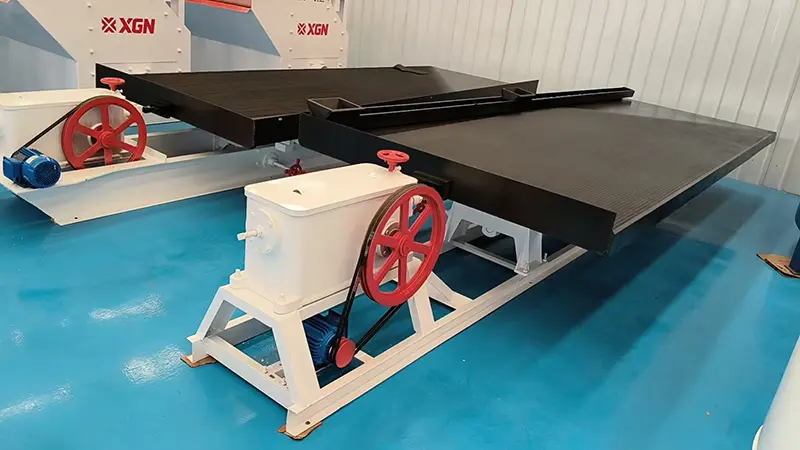
A gold shaking table is a gravity separation machine used to recover gold and other valuable heavy minerals from ore, concentrate, and placer materials. It separates particles according to differences in density and specific gravity while a thin film of flowing water carries lighter particles away from the table surface.
Shaking tables are particularly useful when gold occurs as relatively coarse, liberated particles. They can also be used for cleaning gravity concentrates and improving the grade of a recovered heavy-mineral product.
Unlike chemical extraction methods, a shaking table does not require flotation reagents or leaching chemicals. This makes it an attractive option for certain gravity concentration circuits, especially where a simple and environmentally friendly separation method is preferred.
1. What Is a Gold Shaking Table?
A gold shaking table is a slightly inclined, riffled table deck that moves back and forth horizontally while water flows across its surface.
The combination of:
Table motion
Water flow
Deck inclination
Riffle design
Particle density
Particle size
causes different minerals to follow different paths across the deck.
Dense particles such as liberated gold tend to remain closer to the riffled surface, while lighter gangue particles are carried farther across the table by the flowing water.
The separated products are usually collected as different streams, such as concentrate, middlings, and tailings.
2. Gold Shaking Table Working Principle
The working principle of a shaking table is based primarily on gravity concentration.
When the feed slurry enters the table, water spreads the particles across the deck. The table then moves in a reciprocating motion, creating repeated differential movement between particles.
The separation process can be simplified as:
Feed Slurry → Stratification → Differential Movement → Concentrate Separation
Heavy particles have a greater tendency to settle and remain near the deck surface. Lighter particles are more easily carried by the flowing water.
The riffles help retain and concentrate heavy particles while allowing lighter material to move toward the tailings side of the table.
Why Does Gold Separate?
Gold has a much higher density than most common gangue minerals such as quartz. When gold particles are sufficiently liberated, this density difference can be exploited through gravity concentration.
However, the effectiveness of a shaking table depends strongly on particle size and liberation. Extremely fine or poorly liberated gold may require another recovery method or a combined processing circuit.
3. Main Components of a Gold Shaking Table
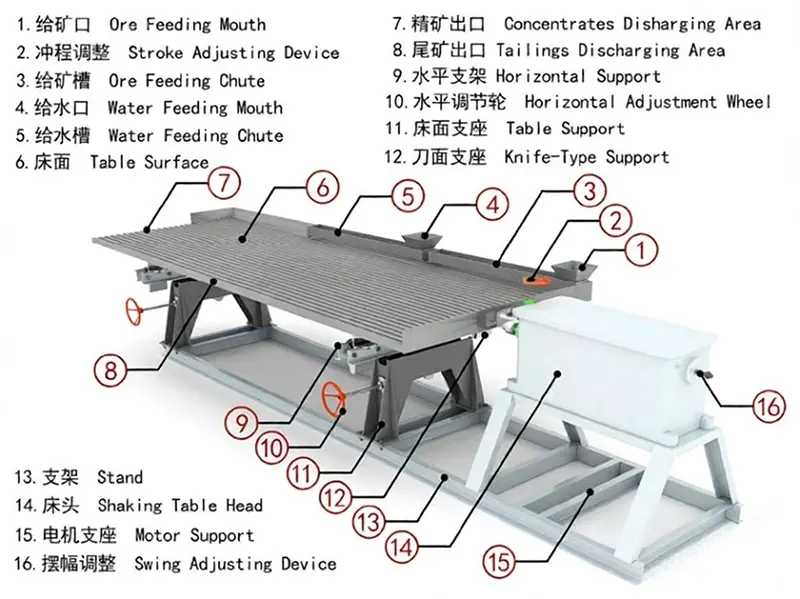
A typical shaking table consists of several important components.
Table Deck
The deck provides the surface where separation takes place. It is normally slightly inclined and fitted with riffles or other surface features.
Drive Mechanism
The drive system produces the table's reciprocating motion.
The stroke length and frequency can influence particle movement and separation performance.
Water Distribution System
Water is supplied across the deck to transport the feed and assist in separating lighter particles from heavier minerals.
Feed Box
The feed box distributes the slurry onto the table deck as evenly as possible.
Concentrate Collection Area
Separate collection zones allow operators to recover different products according to their position on the deck.
4. Types of Gold Shaking Tables
Different shaking table designs are available for different feed materials and applications.
Wilfley-Type Shaking Table
The Wilfley-type design is one of the best-known gravity concentration table configurations.
It uses a riffled deck and reciprocating motion to separate heavy minerals from lighter material.
It can be used for gold, tin, tungsten, chromite, and other heavy minerals.
Fine Sand Shaking Table
Fine sand tables are designed for relatively fine feed.
They are commonly used when the valuable mineral is present in a fine particle-size range that can still be effectively separated by gravity.
Coarse Ore Shaking Table
Coarse-particle tables are used when the feed contains relatively coarse liberated heavy minerals.
The table configuration and operating conditions need to match the feed size distribution.
Concentrate Cleaning Table
A shaking table can also be used as a cleaner in a gravity concentration circuit.
For example, a centrifugal concentrator or jig may first recover a rough concentrate, which is then upgraded on a shaking table to improve product grade.
5. Gold Shaking Table Applications
Gold shaking tables can be used in several types of mineral processing operations.
Alluvial Gold Processing
Shaking tables can recover fine and coarse gold from suitable alluvial concentrates after screening and desliming.
They are generally more effective when the gold is liberated and the feed has been properly classified.
Hard-Rock Gold Processing
In hard-rock gold plants, shaking tables may be used after crushing and grinding to recover gravity-recoverable gold.
A typical circuit could be:
Crushing → Grinding → Classification → Gravity Concentration → Shaking Table
The exact flowsheet depends on the occurrence of gold in the ore.
Gravity Concentrate Cleaning
A shaking table can upgrade a gravity concentrate by separating gold from lighter minerals.
This application can be particularly useful when a higher-grade final concentrate is required.
Heavy Mineral Recovery
Although commonly associated with gold, shaking tables can also recover other high-density minerals, including certain tin, tungsten, chromite, and heavy-mineral concentrates.
6. Factors Affecting Shaking Table Performance
A shaking table does not automatically provide efficient separation simply because the feed contains gold. Several operating parameters need to be controlled.
Feed Particle Size
Particle size has a major influence on gravity separation.
If the feed contains a wide range of particle sizes, coarse and fine particles may behave differently on the table.
Classification and desliming can therefore improve separation in some circuits.
Feed Rate
An excessive feed rate can overload the deck and reduce separation efficiency.
A stable and appropriately controlled feed is generally preferable.
Water Flow
Water transports lighter particles across the table.
Too much water can carry valuable fine particles into the tailings stream, while insufficient water may prevent proper separation.
Table Inclination
The deck angle affects the movement of particles and the position of the separation bands.
The appropriate setting depends on the feed characteristics and desired product.
Stroke and Frequency
The shaking motion influences how particles stratify and move across the deck.
Operating conditions should be adjusted according to particle size and mineral density.
7. Feed Preparation Before a Gold Shaking Table
Good feed preparation can have a significant effect on gravity separation.
Crushing
Large ore particles may need to be crushed to liberate gold from the surrounding rock.
Grinding
Grinding may be required when gold is locked within sulfide minerals or gangue.
However, excessive grinding can generate slimes that are difficult to recover by gravity.
Classification
Hydrocyclones or screens can separate particles into more consistent size fractions before gravity concentration.
Desliming
Excessive slimes can interfere with gravity separation by changing the water flow and particle movement on the table.
Removing a portion of the finest material may therefore improve table performance in some applications.
8. Gold Shaking Table in a Gravity Gold Recovery Circuit
A shaking table is often most effective when integrated with other gravity equipment.
A simplified gravity circuit could be:
Crushing → Grinding → Classification → Gravity Concentrator → Shaking Table → Gold Concentrate
The first gravity stage can recover a broad fraction of gravity-recoverable gold.
The shaking table then performs a more selective cleaning step.
This approach can reduce the amount of material that needs to be treated on the table while improving the quality of the final concentrate.
9. Advantages of Gold Shaking Tables
Shaking tables offer several advantages for suitable applications.
High Selectivity
A properly operated table can produce a relatively high-grade heavy-mineral concentrate.
Simple Separation Mechanism
The process mainly relies on gravity, water flow, and mechanical movement rather than complex chemical reactions.
Low Reagent Requirement
Gravity concentration does not normally require flotation collectors or leaching reagents.
Visual Separation
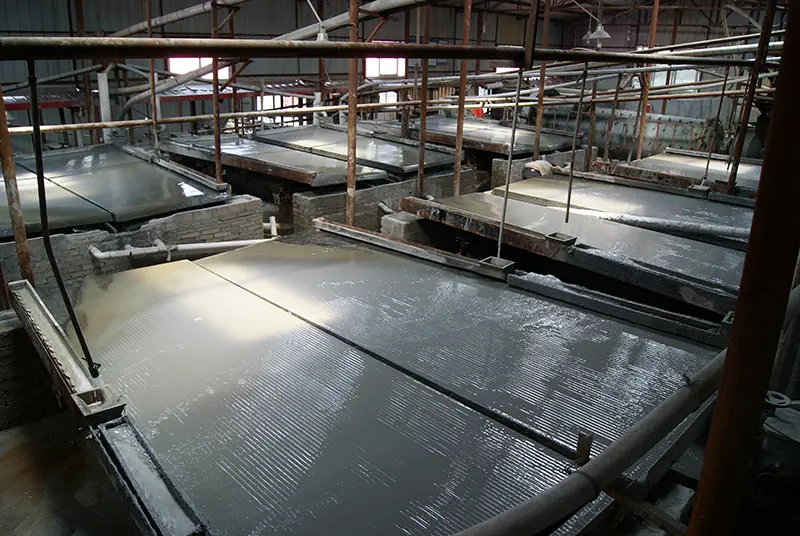
The separation bands on the table can often be observed during operation, allowing operators to monitor the process and adjust operating conditions.
Flexible Applications
Shaking tables can be used for both primary gravity concentration in some circuits and concentrate cleaning.
10. Limitations of Gold Shaking Tables
Despite their advantages, shaking tables are not suitable for every gold ore.
Limited Capacity
Compared with some high-throughput gravity equipment, shaking tables generally have a relatively limited capacity per unit.
Sensitive to Feed Conditions
Changes in feed rate, particle size, water flow, and solids concentration can affect separation.
Floor Space
A large number of tables may require significant installation space when processing high volumes.
Fine Gold Challenges
Very fine gold can be difficult to recover efficiently because small particles are strongly influenced by water flow and surface effects.
Need for Proper Feed Preparation
Poorly classified or excessively muddy feed can reduce the effectiveness of gravity separation.
11. Gold Shaking Table vs Other Gravity Equipment
A shaking table is only one option for gravity gold recovery.
| Equipment | Main Strength | Typical Application |
|---|---|---|
| Shaking Table | High selectivity | Concentrate cleaning |
| Jig | Good for coarse particles | Gravity concentration |
| Centrifugal Concentrator | High centrifugal force | Fine gravity-recoverable gold |
| Spiral Concentrator | Continuous operation | Heavy mineral concentration |
The best equipment depends on the gold particle size, liberation characteristics, throughput, and required concentrate grade.
In many plants, different gravity machines are combined rather than selecting only one type.
12. How to Improve Gold Recovery on a Shaking Table
Several practical measures can improve table performance.
Maintain a Stable Feed
Avoid sudden changes in slurry flow and solids concentration.
Control Water Addition
Adjust the wash-water flow according to particle size and separation behavior.
Optimize Table Settings
Table inclination, stroke, and operating frequency should be adjusted based on test results.
Reduce Excessive Slimes
Desliming can improve separation when fine clay or slime particles interfere with the gravity process.
Monitor Product Streams
Regular sampling of concentrate, middlings, and tailings helps identify where gold losses are occurring.
13. How to Select a Gold Shaking Table
Before selecting a shaking table, evaluate:
Gold particle size
Gold liberation
Feed capacity
Feed solids concentration
Slime content
Required concentrate grade
Expected recovery
Available installation space
Water availability
Number of required tables
Laboratory or pilot-scale gravity tests are useful for determining whether a shaking table is appropriate for a particular ore.
The table should be selected as part of the complete processing flowsheet rather than as an isolated piece of equipment.
14. Gold Shaking Table Process Flow Example
For a suitable hard-rock gold ore, a simplified process may look like:
Raw Ore
↓
Jaw Crusher
↓
Grinding Mill
↓
Classification
↓
Gravity Concentration
↓
Gold Shaking Table
↓
Gold Concentrate
↓
Concentrate Cleaning or Further Treatment
The actual process can be modified according to gold liberation, mineralogy, and the required recovery target.
Conclusion
A gold shaking table is a gravity separation machine that uses table motion, water flow, and differences in mineral density to separate gold from lighter materials.
It is particularly useful for recovering relatively coarse or liberated gold and for cleaning gravity concentrates. Its performance depends strongly on feed preparation, particle size, water flow, table inclination, stroke, and feed rate.
Because shaking tables have limited capacity and can be sensitive to fine slimes, they are often used together with crushers, grinding mills, classifiers, centrifugal concentrators, or jigs rather than operating as a standalone recovery solution.
For a new gold processing project, gravity separation tests should be conducted before selecting the equipment. The final circuit should be designed around the actual gold particle size, liberation characteristics, feed capacity, and recovery requirements.